

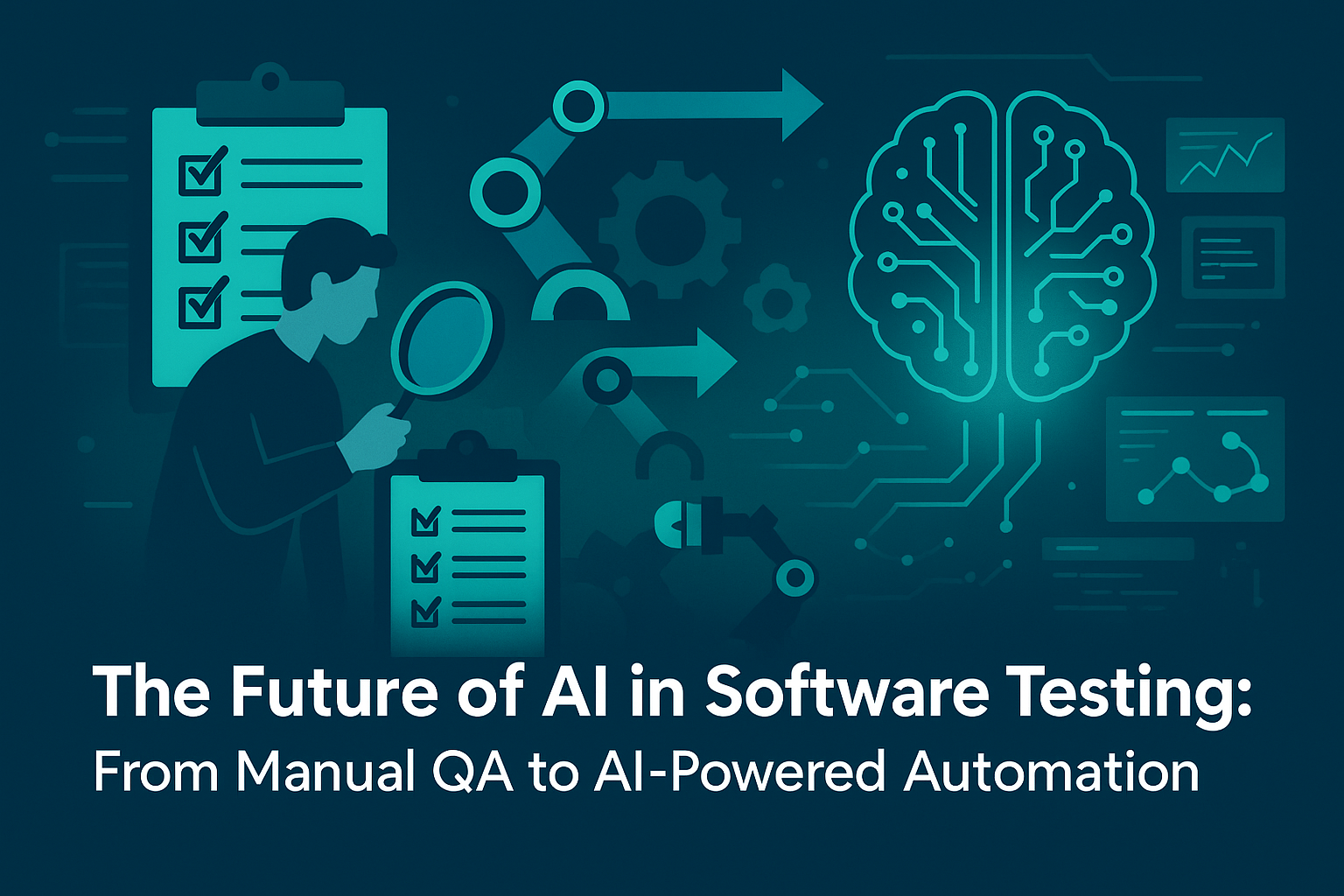
The Future of Software Testing: From Manual QA to AI-Powered Automation
AI in software testing is no longer a futuristic concept—it is redefining how organisations deliver reliable, high-quality software in today’s digital-first economy. For years, businesses have relied on traditional manual quality assurance (QA) to ensure applications met user expectations. But as systems grew in complexity and speed-to-market became critical, manual methods struggled to keep up. This is where artificial intelligence (AI) enters the conversation, transforming not only how testing is performed but also how we think about quality itself.
So, what is AI in software testing? At its core, it refers to the integration of intelligent algorithms, machine learning, and data-driven models into the testing process. Unlike traditional automation scripts that rely on rigid pre-programmed instructions, AI-driven testing adapts, learns, and predicts outcomes based on real-world data. This makes testing smarter, faster, and more aligned with the dynamic nature of modern applications.
The role of AI in software testing is already proving to be pivotal. AI is enabling predictive defect analysis, automatic test case generation, and even self-healing automation frameworks that adapt to code changes without human intervention. This shift is vital because, according to Gartner, organisations that integrate AI and machine learning into their DevOps pipelines are seeing up to a 20% reduction in testing time and costs (Gartner, 2024). Such outcomes illustrate that artificial intelligence in software testing is not just about efficiency—it is about unlocking new levels of innovation and reliability.
In the past, QA teams relied heavily on manual testing. Testers would spend hours writing cases, executing scenarios, and manually logging results. While effective in smaller projects, this approach became unsustainable as digital ecosystems expanded across mobile, web, and cloud. The introduction of automation tools like Selenium and JUnit helped bridge the gap, but these frameworks still required constant maintenance and lacked adaptability. AI has arrived as the natural next step in this evolution, creating systems capable of autonomous decision-making, predictive analytics, and intelligent error detection.
At EmporionSoft, we recognise that businesses can no longer rely solely on legacy testing methods if they want to remain competitive. Our QA and development services are designed to integrate emerging technologies with proven testing practices, helping organisations transition smoothly from traditional automation to AI-powered solutions. This blend of expertise allows enterprises to embrace change without disrupting their delivery cycles. You can explore our comprehensive offerings through our services page.
Artificial intelligence in software testing is not merely a tool—it is a strategic enabler. By embedding AI into QA processes, organisations gain the ability to identify risks earlier, test at scale, and ensure flawless customer experiences. More importantly, AI shifts the focus from reactive defect detection to proactive quality assurance, ensuring that applications are built with resilience and user satisfaction in mind from the very start.
Yet, this transformation does not happen overnight. It requires cultural shifts, investment in training, and a clear understanding of how AI integrates into existing testing pipelines. Companies that fail to adapt risk being left behind in an era where software quality directly impacts reputation, revenue, and user trust.
As we look ahead, the future of testing is clear: intelligent automation will dominate, and human testers will evolve into strategic quality leaders, focusing on creativity, edge-case design, and oversight of AI-driven systems. In the following sections, we will explore how manual QA compares to AI-powered testing, the practical benefits AI brings, real-world use cases, and how organisations can prepare for the next wave of innovation in software quality assurance.
Manual QA vs Automation: Setting the Stage for AI
Software testing has always been a critical part of delivering dependable applications. For decades, quality assurance teams relied on manual testing, where human testers followed step-by-step instructions to verify functionality. While effective in smaller environments, manual QA faced significant barriers as digital ecosystems became more complex. The emergence of automation tools promised relief, but even they had limitations. Today, the industry stands at a crossroads where AI in testing software is reshaping the landscape entirely.
Manual Testing Limitations
Manual testing played a vital role in the early stages of software development. Testers meticulously executed cases, reported bugs, and validated requirements. Yet, this approach soon revealed its flaws.
-
Time-consuming: Large projects required thousands of test cases, leading to lengthy cycles that slowed delivery.
-
Human error: Even the most skilled testers could overlook defects or inconsistencies.
-
Limited scalability: Testing across multiple platforms, devices, and browsers was nearly impossible to manage manually.
As software moved toward continuous integration and delivery, these inefficiencies became glaring. Manual QA could not keep pace with the demands of rapid iteration, making innovation harder to achieve.
Rise of Automation Tools
To address these challenges, automation frameworks such as Selenium, JUnit, and QTP gained popularity. Automation reduced the need for repetitive manual effort, improving speed and accuracy. It allowed teams to rerun tests consistently and validate core functionality with less human intervention.
The benefits were clear:
-
Repeatability for regression testing.
-
Faster execution across environments.
-
Cost savings through reduced reliance on large QA teams.
However, automation was not without drawbacks. Scripts required frequent maintenance, particularly when applications underwent UI or logic changes. Test coverage still depended on predefined scripts, which meant that automation lacked adaptability. This rigidity created bottlenecks whenever applications evolved quickly.
Modern businesses adopting Adaptive Software Development frameworks need more flexible testing solutions. Automation helped, but it did not eliminate the unpredictability of today’s fast-paced digital world.
Bridging to AI
This is where AI tools in software testing take centre stage. Unlike traditional automation, AI does not rely solely on fixed scripts. Instead, it learns from data, adapts to changes, and predicts where defects are most likely to occur. This shift represents a leap in capability, enabling proactive rather than reactive quality assurance.
Key advantages of AI tools used in software testing include:
-
Self-healing scripts: Automation frameworks that automatically adjust when an element changes.
-
Predictive analytics: Identifying risk-prone areas before defects surface in production.
-
Visual validation: Using machine learning to detect UI anomalies across devices.
-
Smarter test creation: AI generates new test cases by analysing user journeys and historical bug data.
According to BrowserStack (2024), organisations implementing AI-driven testing saw up to 40% improvement in defect detection and 30% faster release cycles. These gains highlight why AI is not just an incremental improvement—it is the foundation for future-proof quality strategies.
This evolution also aligns with broader shifts in project delivery. Businesses leveraging modern project management tools for tech companies understand that agility and intelligence must extend across the entire software lifecycle. AI in testing is an essential component of that ecosystem.
Moving Forward
The progression from manual QA to automation and now to AI illustrates the industry’s constant pursuit of efficiency and accuracy. Manual methods built the foundation, automation addressed scalability, but AI introduces adaptability and foresight. For companies that want to remain competitive, adopting AI-driven testing is no longer optional—it is a strategic necessity.
In the next section, we will explore the tangible benefits of AI in software testing, from reducing costs to accelerating release cycles, and why forward-thinking organisations are making this investment today.
The Benefits of AI in Software Testing
In the fast-paced digital economy, businesses are under constant pressure to release high-quality software quickly and cost-effectively. Traditional methods of testing often struggle to keep up, but artificial intelligence offers a smarter solution. The benefits of AI in software testing extend far beyond efficiency, delivering measurable improvements in cost reduction, accuracy, and speed. By shifting towards intelligent automation, organisations are transforming testing into a competitive advantage.
Cost Efficiency
One of the most compelling AI use cases in software testing is cost optimisation. Manual QA and even scripted automation can drain budgets due to the high number of test cases, the need for frequent updates, and the extensive involvement of human testers. By contrast, AI introduces intelligent test creation, prioritisation, and maintenance.
-
Reduced labour costs: AI systems can execute thousands of test cases automatically, reducing dependency on large QA teams.
-
Optimised test coverage: Instead of running every test case, AI prioritises the most relevant ones, saving both time and money.
-
Self-healing scripts: When applications evolve, AI frameworks adapt without requiring costly rework.
According to McKinsey (2023), companies that adopted AI in testing reported up to 20% lower QA expenditure while simultaneously improving coverage. This illustrates that using AI in software testing is not just about innovation—it is about financial sustainability.
At EmporionSoft, we design solutions that balance innovation with resilience. For example, our approach to building resilient software ensures businesses minimise costs while maintaining robust testing practices.
Improved Accuracy & Coverage
Human testers are limited by time, attention, and fatigue. Even automated scripts can miss issues if they are not designed to anticipate unexpected changes. AI addresses these challenges by leveraging data-driven insights and machine learning models to expand coverage and improve defect detection.
-
Predictive defect analysis: AI identifies areas of code most likely to contain errors.
-
Visual validation: Machine learning detects subtle UI inconsistencies across browsers and devices.
-
Data-driven decision-making: Historical bug reports and user data help AI prioritise high-risk areas.
This results in a testing process that is not only broader in scope but also deeper in accuracy. By capturing issues earlier in the lifecycle, AI reduces the risk of production failures and costly post-release fixes.
Real-world case studies show how companies adopting AI-driven QA frameworks have significantly reduced defect leakage, ensuring smoother product launches and enhanced customer satisfaction.
Faster Release Cycles
In today’s agile and DevOps-driven environments, speed is as important as quality. Businesses must deliver updates quickly to remain competitive, but this often comes at the cost of testing rigour. AI changes this balance by automating repetitive tasks and accelerating test execution without compromising quality.
-
Continuous testing: AI integrates seamlessly with CI/CD pipelines, enabling real-time validation.
-
Parallel execution: Thousands of tests can run simultaneously across platforms.
-
Proactive risk management: AI anticipates defects before they impact the delivery pipeline.
These capabilities empower organisations to release updates faster while maintaining confidence in software performance. Accenture’s 2024 report noted that enterprises deploying AI in their QA cycles achieved 25–30% quicker release times compared to those relying solely on manual or script-based testing.
For modern businesses, this means shorter time-to-market, greater agility, and the ability to respond rapidly to customer demands or market shifts.
The Bigger Picture
The AI use in software testing is not merely an incremental improvement; it represents a paradigm shift. By lowering costs, enhancing accuracy, and accelerating delivery, AI transforms testing into a strategic enabler of digital transformation. Companies that embrace this shift position themselves to innovate faster, serve customers better, and sustain long-term growth.
As we continue, the next section will dive into specific AI use cases in software testing, showcasing how real-world businesses are already leveraging these benefits to revolutionise their QA strategies.
AI and Machine Learning Use Cases in Software Testing
The adoption of AI and machine learning in software testing is no longer experimental—it is practical, scalable, and increasingly essential. As applications grow in complexity, traditional QA methods fall short in ensuring quality at the speed modern businesses demand. The role of AI in software testing is to bridge this gap by automating routine tasks, predicting potential issues, and learning continuously from past data. Real-world applications from industry leaders like IBM, Microsoft, and ThoughtWorks demonstrate how transformative these technologies have become.
Defect Prediction and Risk Analysis
One of the most powerful AI and ML in software testing use cases is predictive defect analysis. Rather than waiting for issues to surface during regression or production, AI models analyse historical test data, code changes, and bug reports to predict where defects are most likely to occur.
-
Proactive detection: AI identifies risk-prone areas early in development.
-
Resource optimisation: Testers can prioritise high-risk modules, saving time.
-
Reduced production failures: By addressing issues earlier, businesses avoid costly downtime.
For example, IBM’s AI-driven testing platforms use machine learning to predict failure patterns and reduce defect leakage significantly. This proactive approach illustrates how AI can be used in software testing to improve reliability before users ever encounter problems.
Visual Testing and User Experience Validation
Applications today must perform consistently across countless browsers, devices, and operating systems. Manual visual validation is resource-intensive, and even traditional automation cannot always detect subtle issues. AI-based visual testing changes that.
-
Image comparison models: AI identifies pixel-level UI inconsistencies.
-
Device diversity: Testing across multiple resolutions and platforms simultaneously.
-
Enhanced UX assurance: Ensures layout and branding remain intact across interfaces.
Microsoft has incorporated AI into its Azure DevOps testing suite, enabling continuous validation of visual interfaces at scale. This demonstrates the growing role of machine learning in ensuring end-user experience remains seamless and brand-consistent.
Intelligent Test Case Generation
Another vital application is automated test case creation. Traditionally, QA teams spend hours writing, updating, and maintaining test cases. AI drastically reduces this workload by analysing application flows, historical bug data, and user journeys to generate relevant test cases dynamically.
-
Coverage expansion: AI creates cases for scenarios testers may overlook.
-
Self-healing capability: When application logic changes, test cases adapt automatically.
-
Efficiency: Significant reduction in manual scripting effort.
ThoughtWorks has reported success in integrating AI-driven test generation into agile pipelines, allowing teams to scale QA practices without increasing headcount. This is a tangible example of AI and machine learning in software testing driving measurable productivity gains.
Continuous and Real-Time Testing
In the era of DevOps and CI/CD pipelines, testing can no longer be an isolated stage. AI enables continuous, real-time validation, ensuring quality is integrated throughout the lifecycle.
-
Continuous monitoring: AI algorithms check software health as code is committed.
-
Real-time defect alerts: Issues are flagged instantly for faster resolution.
-
Adaptive feedback loops: Machine learning improves accuracy with each iteration.
This aligns with broader business strategies, such as those discussed in EmporionSoft’s Real-Time AI in Production. Integrating real-time AI validation ensures stability while accelerating deployment cycles.
The Bigger Impact
These use cases highlight how AI can be used in software testing to go beyond simple automation. By embedding intelligence into the QA process, companies gain the ability to anticipate problems, ensure flawless user experiences, and release software faster with greater confidence.
For organisations navigating digital transformation, the implications are clear. As EmporionSoft outlines in How AI is Revolutionising Software Development, the integration of intelligent technologies is not a matter of if but when. Businesses that delay risk falling behind competitors who are already leveraging AI to deliver more reliable and customer-centric applications.
Looking Ahead
The future of quality assurance lies in smarter, self-learning systems that enhance both accuracy and efficiency. From defect prediction to visual validation and dynamic test creation, the role of AI in software testing is rapidly expanding. In the next section, we will explore how generative AI and agentic AI are pushing these capabilities even further, creating autonomous QA agents capable of reshaping the very foundation of software testing.
Generative and Agentic AI in Software Testing
The emergence of generative AI in software testing and autonomous AI agents represents the next major evolution in quality assurance. While traditional AI-driven tools focus on automation, prediction, and defect detection, generative and agentic models introduce creativity, adaptability, and autonomy into testing processes. These technologies are not just optimising existing workflows—they are reimagining what software testing can achieve.
Generative AI in Testing
Generative AI (Gen AI) refers to systems capable of creating new artefacts, from text and code to test cases and datasets. In software testing, this means:
-
Dynamic test case generation: AI generates test scenarios based on natural language requirements, reducing reliance on manual scripting.
-
Synthetic data creation: Gen AI builds realistic test datasets where sensitive or limited production data cannot be used.
-
Exploratory testing support: AI simulates diverse user behaviours, uncovering edge cases that human testers may not anticipate.
For example, developers can provide natural language prompts such as “test login with invalid credentials” and Gen AI will generate scripts tailored to the application under test. According to the Stanford AI Index Report (2024), generative models are already accelerating QA productivity by up to 30% in early adopter organisations.
Agentic AI and Autonomous Testing
While Gen AI focuses on creation, agentic AI in software testing introduces autonomous problem-solving. AI agents in software testing act like digital colleagues, capable of analysing codebases, identifying gaps, executing tests, and even fixing scripts without human intervention.
Key features include:
-
Self-healing automation: When UI elements change, agents adapt scripts automatically.
-
Autonomous exploration: AI agents identify new areas to test, beyond predefined scenarios.
-
Continuous learning: Agents improve their accuracy over time by incorporating results from previous test cycles.
This approach represents a shift towards autonomous QA pipelines, where human testers become strategic supervisors rather than script maintainers. NIST’s 2023 guidelines on trustworthy AI emphasise that agentic systems must be transparent, reliable, and ethically aligned—a critical factor for enterprises adopting these technologies at scale.
Diagram-Style Explanation
To conceptualise the relationship between traditional AI, generative AI, and agentic AI in testing, consider this structured flow:
[Manual QA] → Limited scalability, time-consuming

[Traditional Automation] → Scripted, repeatable, but rigid

[AI-Enhanced Testing] → Predictive, adaptive, faster execution

[Generative AI] → Creates test cases, datasets, exploratory flows dynamically

[Agentic AI] → Autonomous agents manage, heal, and evolve testing pipelines
This continuum shows how the field has advanced from human-led validation to intelligent, autonomous systems capable of redefining QA practices.
Challenges and Ethical Considerations
The integration of gen AI in software testing is not without risks. Issues such as data privacy, model bias, and over-reliance on machine decisions must be carefully managed. Ethical frameworks play a crucial role here. At EmporionSoft, we emphasise responsible adoption, aligning with insights outlined in our article on Ethics in AI. Ensuring transparency and accountability in AI agents’ decision-making processes will be essential to building trust in these systems.
Additionally, managing and scaling large models used for generative and agentic AI testing requires robust operational strategies. EmporionSoft’s work with LLMOps provides a framework for safely deploying and monitoring these complex systems in production environments.
Looking Ahead
Generative and agentic AI signify a future where testing is not merely automated but intelligent and autonomous. Generative models will continuously supply fresh, relevant test cases, while AI agents will oversee and adapt entire QA ecosystems. Human testers will evolve into curators and strategists, guiding these systems while focusing on creativity and higher-level problem-solving.
The combination of these technologies points towards a new era of proactive, self-sustaining quality assurance. As the Stanford AI Index suggests, enterprises adopting generative and agentic AI early will gain a competitive edge in delivering secure, resilient, and user-centric software.
In the next section, we will explore how testers and organisations can prepare themselves—through training, tools, and courses—to embrace this AI-driven transformation in software quality assurance.
Learning AI in Software Testing: Courses, Skills, and Tools
As artificial intelligence becomes a cornerstone of modern QA, professionals must adapt. Manual testers and traditional automation engineers can no longer rely on legacy skills alone. Instead, they must embrace structured learning paths, practical experience, and exposure to advanced tools. The demand for skills in AI in software testing course programmes is growing rapidly, with opportunities available across online platforms, professional workshops, and industry-driven internships.
Why Upskilling Matters
Software development is evolving at a relentless pace, and testing must keep up. Testers who understand AI concepts gain the ability to work with predictive analytics, machine learning frameworks, and automated case generation. As highlighted in EmporionSoft’s Software Developer’s Roadmap 2025, continuous learning is no longer optional—it is the backbone of a sustainable technology career.
Upskilling in AI for testing also makes professionals more attractive in the job market. Organisations increasingly look for testers who can bridge traditional QA methods with AI-enabled pipelines. By pursuing an AI in software testing course online, individuals can gain certifications that demonstrate their readiness for the future.
Recommended Online Courses
Fortunately, there is no shortage of accessible and high-quality learning platforms:
-
Coursera: Offers courses on machine learning, AI for everyone, and applied AI testing frameworks. Many are developed in collaboration with universities such as Stanford or companies like Google.
-
Udemy: Provides tailored AI in software testing Udemy courses focusing on automation integration, visual testing, and real-world QA workflows. Popular among beginners for its affordability.
-
EdX: Features academic-grade modules on AI, ML, and their role in testing environments, suitable for those seeking structured pathways.
Beginners may consider enrolling in an AI in software testing course for beginners to cover foundational concepts such as supervised learning, neural networks, and test automation principles. For professionals seeking structured knowledge, recorded lectures, downloadable notes, and interactive projects often come in the form of an AI in software testing PPT resource.
Key Skills to Develop
Enrolling in courses is only the first step. To remain competitive, testers should focus on building practical competencies in:
-
Machine learning fundamentals: Understanding classification, regression, and clustering for defect prediction.
-
Natural language processing: Useful in test case generation and log analysis.
-
Data analysis and visualisation: To interpret and present results effectively.
-
Continuous integration skills: Integrating AI-driven tools within CI/CD pipelines.
These skills not only increase individual efficiency but also contribute to building more resilient QA frameworks across organisations.
Essential AI-Driven Testing Tools
Alongside learning theory, testers must familiarise themselves with the tools shaping the future of QA:
-
Testim: Uses machine learning to create stable, self-healing automated tests.
-
Applitools: Leverages AI for advanced visual testing and cross-platform validation.
-
Selenium + AI extensions: Traditional automation enhanced with AI plugins for smarter, adaptive testing.
Practical experience with these platforms often complements online learning. Many courses now include free trials or labs to help learners gain hands-on exposure.
Practical Pathways
For learners seeking a structured journey, combining online education with industry experience is essential. EmporionSoft offers internship opportunities where students and graduates can apply AI concepts to real-world testing scenarios. This blend of classroom knowledge and hands-on projects is invaluable in preparing testers for AI-powered roles.
The Way Forward
By leveraging platforms such as Coursera, Udemy, and EdX, testers at all levels can access knowledge that was once reserved for AI specialists. When combined with practical skills and hands-on projects, these courses empower QA professionals to move confidently into the age of intelligent testing.
As the industry embraces AI, those who invest in their skills now will be best positioned to lead the future of quality assurance. In the next section, we will examine what lies ahead: the broader outlook for AI in software testing, and how organisations can prepare for the rise of autonomous QA pipelines.
The Future of AI in Software Testing
The trajectory of AI in software testing suggests a future defined by autonomy, speed, and intelligence. As technology ecosystems become more complex and businesses push for rapid digital transformation, AI is moving beyond supportive tools into central enablers of quality assurance. The convergence of AI ML in software testing with DevOps and cloud-native development is setting the stage for self-governing QA pipelines that continuously validate software performance without human intervention.
Autonomous QA Pipelines
In the future, testing will no longer be a separate stage in the development lifecycle—it will be a seamlessly integrated function. Autonomous pipelines powered by AI will:
-
Detect and fix issues in real time: AI models will monitor systems continuously and apply corrective actions automatically.
-
Generate adaptive test cases: As applications evolve, AI will dynamically produce new scenarios.
-
Optimise resource allocation: Machine learning will determine the right balance of depth and speed for each test run.
This represents a radical departure from current practices. Human testers will shift towards supervisory roles, ensuring ethical alignment and providing creative oversight, while intelligent systems handle the bulk of execution.
Continuous Testing at Scale
Agility is already a cornerstone of modern development, but AI will amplify this by enabling testing at an unprecedented scale. AI tools in software testing will integrate into CI/CD pipelines, validating every code commit instantly.
Key benefits include:
-
Early defect detection: Reducing costly post-release fixes.
-
Broader coverage: Thousands of scenarios can be executed across environments simultaneously.
-
Real-time reporting: Dashboards fuelled by AI will provide stakeholders with instant visibility.
Deloitte’s 2024 report on AI adoption notes that enterprises deploying AI-driven continuous testing achieved 35% faster delivery cycles and significant improvements in reliability. This underlines that the future of AI in testing software is not about incremental improvement—it is about reshaping how organisations deliver value.
Agentic Collaboration and AI-Driven Teams
The next evolution will be the rise of agentic AI collaboration. AI agents will act as co-workers in QA teams, handling repetitive tasks, suggesting optimisations, and even debating approaches with human testers. These agents will:
-
Learn continuously: Drawing insights from each sprint or release.
-
Collaborate in real time: Offering recommendations within IDEs or project management tools.
-
Expand creativity: Suggesting unconventional test scenarios that humans may overlook.
This kind of collaboration will not replace human testers but augment their capabilities. Ethical oversight will remain critical, particularly as AI-driven systems make more autonomous decisions. EmporionSoft’s article on the Future of Cloud Computing highlights how interconnected systems and distributed infrastructures will depend on intelligent testing agents to maintain resilience across global deployments.
Preparing for What’s Next
The transformation of software testing will also influence broader strategic approaches. Enterprises will need to adopt robust governance models to ensure AI adoption remains transparent, accountable, and fair. This aligns with the insights available in EmporionSoft’s Our Insights hub, which explores the ethical and operational challenges of next-generation technology adoption.
PwC predicts that AI adoption across software engineering could contribute trillions in global economic value by 2030, with quality assurance being a major driver. For organisations, this makes the integration of AI into testing pipelines not a matter of innovation, but survival.
Looking Ahead
From autonomous pipelines and real-time validation to agentic collaboration, the evolution of QA is accelerating. The future belongs to organisations that can adapt, combining human creativity with machine intelligence to ensure speed, accuracy, and reliability.
In the final section, we will examine how businesses can act now—partnering with the right technology providers and adopting strategic practices—to make the shift towards AI-driven quality assurance with confidence.
Making the Shift: Why Partner with EmporionSoft for AI-Driven QA
The journey from manual quality assurance to fully autonomous, AI-powered testing reflects the broader evolution of software development itself. Where once testers manually executed scripts line by line, today’s intelligent systems can predict defects, generate new cases, and adapt instantly to changing codebases. This transition is more than a technological upgrade—it is a business imperative. The role of AI in software testing has moved from experimental to essential, and organisations that act now will reap the rewards of resilience, speed, and innovation.
From Manual QA to Intelligent Automation
Manual QA laid the foundations of software reliability, but its limitations in scalability and efficiency quickly became clear. Automation brought consistency and speed, yet remained dependent on human-written scripts that required constant maintenance. AI has changed the equation entirely. Through machine learning and intelligent agents, businesses now benefit from predictive analytics, real-time validation, and adaptive frameworks that continuously improve.
By embracing this shift, organisations no longer treat testing as a bottleneck but as a driver of competitive advantage. This is why companies that successfully integrate AI into QA pipelines consistently achieve faster release cycles, higher product quality, and lower long-term costs.
The Benefits and Opportunities Ahead
The benefits of AI in software testing have been made clear throughout this exploration. Cost efficiency is achieved by reducing manual effort and optimising resources. Accuracy improves through predictive defect detection and visual validation. Release cycles shorten as continuous testing ensures quality is embedded from day one.
But the opportunities extend even further. Generative AI promises dynamic case generation and synthetic data creation, while agentic AI introduces autonomous agents capable of managing entire pipelines. Together, these advances enable proactive quality assurance, freeing human testers to focus on strategy, creativity, and ethical oversight.
Looking forward, industries that rely heavily on digital services—from finance to healthcare—will find these capabilities indispensable. Deloitte and PwC forecast that AI adoption in software engineering will be one of the largest contributors to business productivity gains this decade. For any enterprise, failing to adopt AI in QA is equivalent to conceding ground to more agile competitors.
Why Invest Now
Timing is critical. The longer businesses delay adopting AI in software testing, the greater the gap becomes between them and forward-thinking competitors. Integrating AI into QA today allows teams to experiment, refine, and scale before AI-driven testing becomes the industry norm. Early adopters will build institutional knowledge and cultural readiness, while late movers will scramble to catch up.
At EmporionSoft, we understand this urgency. Our services are designed to help organisations embrace AI strategically, ensuring that adoption aligns with both technical and business objectives. From consultancy and pilot projects to full integration, we guide enterprises at every step of their journey.
Whether you are exploring AI-enabled automation, implementing generative models, or deploying full QA pipelines, EmporionSoft combines technical expertise with a proven track record of innovation. You can discuss your needs directly with our team through our consultation page or connect with us for tailored solutions via contact us.
A Trusted Partner for the Future
Choosing the right partner is as important as adopting the right tools. EmporionSoft’s global experience, coupled with a deep focus on AI-driven development and testing, positions us as a trusted collaborator for businesses ready to modernise their QA. We take pride in bridging the gap between innovation and practicality—delivering solutions that not only leverage AI but also remain aligned with long-term business goals.
For further insights into the transformative power of AI across industries, you can also explore resources from our peers at TheCodeV, who share a vision of shaping the future through intelligent software solutions.
The Final Word
The transition from manual QA to AI-powered testing is no longer optional—it is the pathway to survival and success in a digital economy. By investing now, businesses can future-proof their products, deliver with confidence, and secure a competitive edge.
Partner with EmporionSoft today, and ensure your software testing evolves with the intelligence, speed, and adaptability that tomorrow demands. The future of software quality is here—make sure you are ready to lead it.