
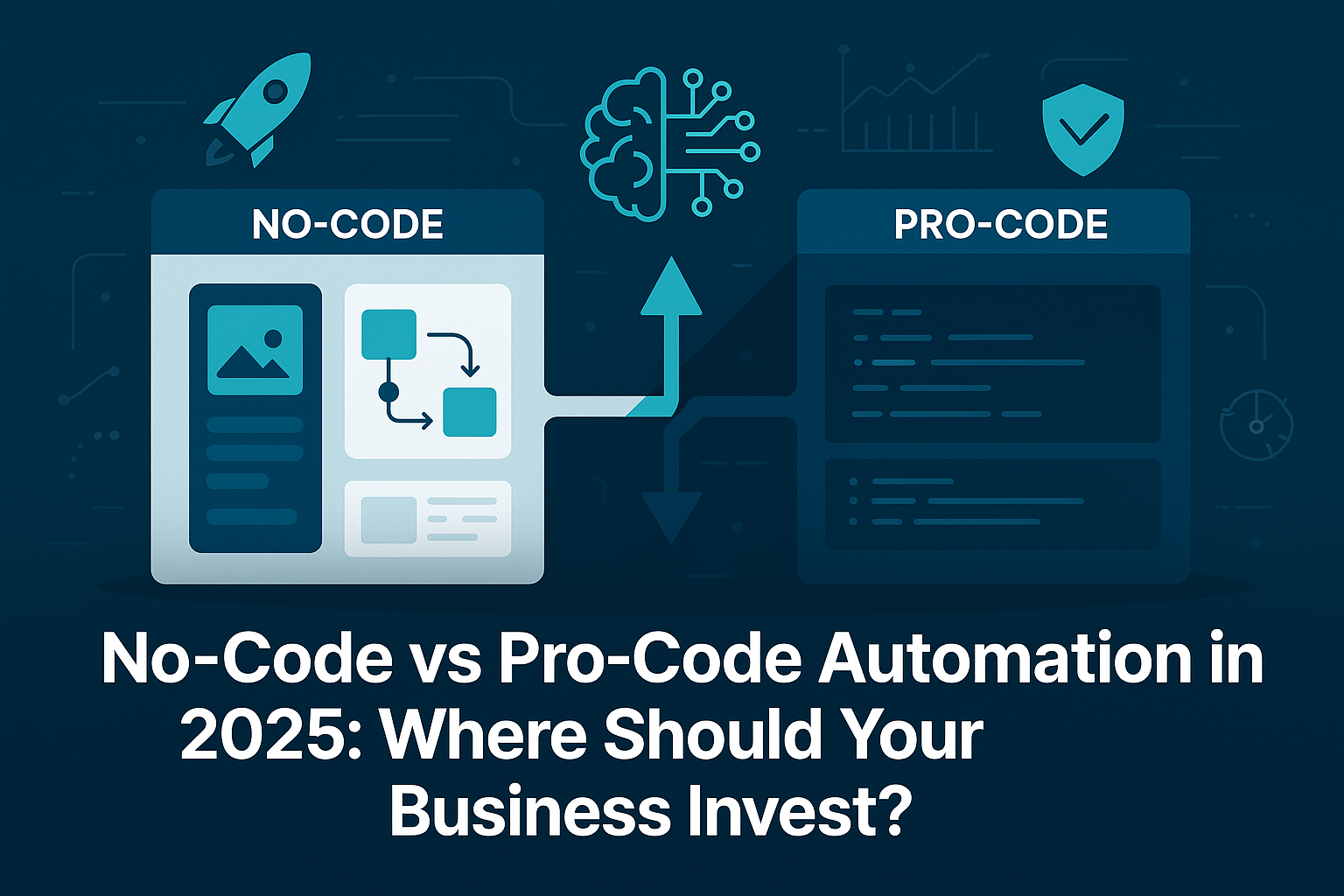
No-Code vs Pro-Code Automation in 2025: Where Should Your Business Invest?
In 2025, the race towards digital automation has never been more intense. Organisations of every size are seeking faster, smarter, and more cost-efficient ways to innovate, and the debate around No-code vs pro-code automation has become central to this transformation. With automation shaping everything from finance to customer support, businesses are now forced to decide: should they empower non-technical teams with simplified tools, or continue investing in highly customisable, developer-driven systems?
The Rise of Automation in 2025
Automation is no longer a luxury; it’s a strategic necessity. According to a Gartner report, by 2026, over 75% of enterprises will adopt some form of no-code or low-code automation to accelerate digital transformation. This surge reflects both the growing demand for speed and the global shortage of skilled software developers. Businesses cannot afford to delay projects, making automation a lifeline for innovation and competitiveness.
At the same time, pro-code automation remains a cornerstone for large-scale enterprises that require robust, secure, and deeply integrated systems. The tension between agility and scalability has never been sharper, making this debate critical in 2025.
What is No-Code Automation?
No-code automation refers to platforms that allow users to build workflows and applications without writing traditional code. Instead, these tools rely on drag-and-drop interfaces, pre-built templates, and visual logic. Marketing teams, HR departments, and even small business owners can make no code automation solutions without relying on technical staff.
Popular examples include no code automation software such as Zapier, Airtable, and Integromat, which empower users to connect applications, automate tasks, and accelerate productivity without engineering support. This approach democratises automation, giving business users more control over their processes.
Advantages of No-Code Automation
-
Rapid deployment without technical expertise
-
Lower development costs
-
Ideal for startups and SMEs seeking agility
Limitations of No-Code Automation
-
Limited customisation for complex systems
-
Risks of vendor lock-in
-
Potential scalability issues for enterprise-level demands
What is Pro-Code Automation?
Pro-code automation, on the other hand, is rooted in developer-led solutions. These require programming knowledge and often involve advanced frameworks, APIs, and integrations. While more resource-intensive, pro-code automation allows businesses to design highly tailored workflows that align perfectly with their infrastructure.
This is the domain of software engineers who create resilient systems for industries like finance, healthcare, and telecommunications—sectors where precision, compliance, and scalability cannot be compromised. Pro-code systems are especially critical when businesses need full control over security, performance, and custom features.
Advantages of Pro-Code Automation
-
Maximum flexibility and customisation
-
Enterprise-grade security and compliance
-
Better scalability for high-growth organisations
Limitations of Pro-Code Automation
-
Longer development cycles
-
Higher costs compared to no-code tools
-
Dependence on skilled developers
Why This Debate Matters Now
The No-code vs pro-code automation debate is not just theoretical—it influences real investment decisions. With the global shortage of software talent, businesses must balance agility with complexity. No-code automation may suit fast-moving teams that need quick wins, while pro-code solutions remain indispensable for organisations with complex, mission-critical needs.
This decision also affects cost structures. While no-code tools reduce upfront investment, pro-code automation may deliver stronger long-term ROI by ensuring scalability and avoiding limitations. The choice will define whether a company thrives in the new era of digital-first business.
What is No-Code Automation and Why Businesses Love It in 2025
In 2025, no code automation has shifted from a niche solution into a mainstream business strategy. Organisations now recognise that speed, accessibility, and cost-effectiveness often matter more than deep technical complexity. Whether in startups or multinational enterprises, the adoption of no-code automation is accelerating because it empowers teams to innovate without waiting for scarce developer resources.
Defining No-Code Automation
At its core, no-code automation allows users to design and launch automated workflows without writing traditional programming code. Instead, they rely on intuitive drag-and-drop interfaces, pre-built connectors, and visual builders. This approach transforms automation into a skill accessible to non-technical staff, such as marketers, HR managers, or customer service representatives.
No-code tools have evolved rapidly. Today, no code automation software like Zapier, Airtable, and Make are supplemented by no code AI automation platforms, which integrate machine learning and natural language processing into simple interfaces. These tools bring advanced capabilities such as sentiment analysis, predictive analytics, and chatbots to users who have never written a line of code.
Benefits of No-Code Automation
Faster Time to Market
One of the most celebrated benefits is speed. Instead of lengthy development cycles, business users can design and launch automated processes in hours or days. This speed enables organisations to experiment, pivot, and scale far faster than in traditional software development.
Reduced Reliance on Developers
The global shortage of skilled engineers makes developer time both scarce and expensive. By adopting no-code automation, businesses reduce dependency on technical teams, freeing developers to focus on high-value projects. This democratisation ensures that innovation is not bottlenecked by limited technical capacity.
Accessibility and Empowerment
With no-code platforms, employees across departments can contribute directly to digital transformation. Marketing teams automate campaign tracking, HR teams streamline recruitment workflows, and customer service managers deploy no code automation testing for chatbots—all without escalating requests to IT. This accessibility shifts ownership of automation closer to the teams that use it daily.
Industries Adopting No-Code
The appeal of no-code automation is evident across multiple industries:
-
Small and Medium Enterprises (SMEs): SMEs, which often lack large IT departments, use no-code to create customer portals, automate invoices, and manage operations efficiently.
-
Marketing: Marketers rely on no-code workflows for lead management, email campaigns, and analytics dashboards. These teams benefit from faster campaign launches and reduced costs.
-
Customer Service: Contact centres increasingly turn to no code AI automation to deploy chatbots, sentiment analysis tools, and automated ticketing systems. This reduces manual workload while enhancing customer experiences.
For a deeper dive into how AI accelerates this movement, see How AI is Revolutionizing Software Development.
Challenges and Limitations
Despite its popularity, no-code automation is not without its challenges:
-
Complexity Limitations: While excellent for routine processes, no-code tools often struggle with highly customised or large-scale enterprise workflows. Businesses handling sensitive data, such as banks or healthcare providers, may find these platforms insufficient for compliance and security needs.
-
Vendor Lock-In: Many no-code platforms are closed ecosystems. Migrating to another provider or customising deeply within the tool may be difficult, raising long-term dependency concerns.
These challenges highlight why the No-code vs pro-code automation debate remains relevant. Businesses must weigh speed and accessibility against long-term flexibility and control.
The Bigger Picture
As TechCrunch noted in a 2024 report, the no-code market is projected to exceed $45 billion by 2027, driven by rising demand for faster development cycles and democratised digital solutions. Yet, as Harvard Business Review cautions, automation at scale must consider workforce impacts, including job displacement by automation.
The lesson is clear: no-code automation is not a silver bullet, but when implemented thoughtfully, it unlocks enormous value. For many organisations, its accessibility and speed make it the right tool for today’s fast-changing market.
What is Pro-Code Automation and Why Enterprises Still Depend on It
While no-code automation has captured headlines in recent years, pro-code automation continues to form the backbone of enterprise-grade digital transformation. In 2025, large organisations in sectors like finance, healthcare, and telecommunications still rely heavily on developer-led solutions that offer deep customisation, compliance, and scalability. The no code vs pro code automation debate is less about one replacing the other and more about which approach is best suited for a company’s needs.
Defining Pro-Code Automation
Pro-code automation refers to developer-driven solutions where custom scripts, APIs, and frameworks are used to automate workflows, processes, and integrations. Unlike drag-and-drop no-code platforms, pro-code automation requires technical expertise, programming knowledge, and often advanced infrastructure.
This approach gives businesses complete control. Developers can fine-tune processes at the source code level, integrate multiple systems securely, and create enterprise applications that meet industry regulations. The flexibility of pro-code automation ensures it remains indispensable where precision and scale are critical.
Strengths of Pro-Code Automation
Scalability
Enterprises often manage millions of transactions, users, or data points. Pro-code automation supports complex architectures that can scale seamlessly across global infrastructures. For example, fintech companies processing high-frequency transactions require automation pipelines that are not only fast but also capable of handling spikes in demand.
Security
Security remains a non-negotiable factor. No-code tools often struggle to meet stringent regulatory requirements such as HIPAA for healthcare or PCI-DSS for financial services. With pro-code automation, developers can embed security features directly into the workflow, ensuring compliance with industry standards.
Advanced Integrations
Pro-code automation allows organisations to integrate with custom APIs, legacy systems, and advanced cloud environments. Unlike limited no code automation software, which may only offer standard connectors, pro-code enables deep interoperability across platforms. This becomes crucial in enterprises that run hybrid or multi-cloud environments.
For more on how cloud platforms affect these integrations, see our Cloud Providers Comparison 2025.
When Pro-Code Wins Over No-Code
Although best no code test automation tools like Testim or Katalon are excellent for SMEs, enterprise testing often requires the flexibility of developer-driven frameworks such as Selenium, Cypress, or Playwright. These allow custom test scripts, parallel execution, and continuous integration with DevOps pipelines.
Pro-code solutions are particularly dominant in:
-
Fintech: High-frequency trading, fraud detection, and compliance-heavy processes demand security and customisation that no-code cannot deliver.
-
Healthcare: Patient records, diagnostic systems, and medical devices require precise, regulatory-compliant automation only achievable through pro-code.
-
Large-Scale Enterprise Systems: Telecommunications, logistics, and global e-commerce platforms often span multiple geographies and require automation tailored to each region’s compliance rules.
For insights on how enterprises ensure resilience while automating critical systems, explore Building Resilient Software.
Why Enterprises Still Depend on Pro-Code
Deloitte’s 2024 enterprise automation report highlighted that over 60% of Fortune 500 companies still rely on pro-code automation for mission-critical operations. Similarly, Microsoft’s Azure automation services emphasise that enterprise-grade automation must balance flexibility, compliance, and performance. AWS reinforces this view, showcasing pro-code pipelines as the foundation for AI-driven cloud automation.
While no code vs pro code automation may seem like a competition, in reality, both approaches are complementary. Enterprises use no-code for quick wins and smaller workflows but continue to depend on pro-code for the systems that matter most.
The Long-Term Perspective
Looking ahead, hybrid adoption is likely to dominate. Businesses will combine the speed of no-code tools with the robustness of pro-code frameworks, creating layered automation strategies that balance agility with resilience. In this model, pro-code remains the critical enabler of enterprise innovation.
No-Code vs Low-Code vs Pro-Code: Breaking Down the Differences
The debate around no code vs low code vs pro code automation is at the centre of digital transformation strategies in 2025. Each approach comes with distinct advantages and trade-offs, making it crucial for businesses to evaluate carefully before committing to a platform. From fast deployment to advanced integrations, the choice depends on organisational needs, budgets, and long-term growth strategies.
The Three Approaches to Automation
To simplify the discussion, let’s break down the main characteristics of no-code, low-code, and pro-code automation:
| Factor | No-Code Automation | Low-Code Automation | Pro-Code Automation |
|---|---|---|---|
| Who Uses It | Business users, non-technical staff | Business analysts + developers | Professional developers and IT teams |
| Ease of Use | Drag-and-drop, pre-built templates | Mix of visual tools + custom code | Requires coding knowledge |
| Flexibility | Limited to platform features | Moderate – can extend functionality with scripts | Unlimited – highly customisable |
| Speed of Deployment | Fast – hours or days | Medium – days or weeks | Slower – weeks or months |
| Scalability | Best for SMEs and small teams | Good for mid-sized projects | Excellent for enterprise-grade systems |
| Security & Compliance | Basic, dependent on vendor | Moderate – can add compliance features | Strong – fully customisable to meet industry regulations |
| Cost | Low entry costs, subscription-based | Moderate costs | Higher development and maintenance costs |
| Best For | SMEs, marketing, HR, customer service | Mid-sized companies seeking flexibility | Large enterprises in fintech, healthcare, telecom, logistics |
This comparison makes it clear why no-code/low-code vs pro-code is not about choosing one over the other, but about aligning tools with specific business contexts.
The Case for Hybrid Adoption
Increasingly, organisations are adopting a hybrid strategy—blending the agility of no-code with the flexibility of low-code and the depth of pro-code. For example:
-
SMEs might begin with no-code to automate marketing or HR tasks, then introduce low code no code automation tools as operations become more complex.
-
Enterprises often combine low-code platforms with pro-code frameworks, giving non-technical teams autonomy while maintaining developer control for mission-critical systems.
This layered adoption supports resilience. Agile no-code solutions provide quick wins, while pro-code automation ensures compliance, scalability, and advanced customisation. For companies navigating constant market change, hybrid adoption aligns well with Adaptive Software Development, where flexibility and iteration are prioritised.
Why the Differences Matter
Choosing between no-code, low-code, and pro-code is more than a technical decision—it shapes team dynamics, resource allocation, and long-term competitiveness. No-code empowers non-technical staff, low-code bridges collaboration between business users and developers, and pro-code equips enterprises with the depth they need to scale globally.
However, Gartner’s 2024 Low-Code Market Forecast emphasises that low-code adoption is expected to grow by 20% annually, driven by demand for faster delivery without sacrificing flexibility. IDC echoes this, noting that by 2027, over 75% of enterprises will deploy a combination of no-code, low-code, and pro-code automation to balance speed with complexity.
Building the Right Framework
Ultimately, there is no one-size-fits-all. The question of no code vs low code vs pro code comes down to context:
-
Startups lean toward no-code for agility and lower costs.
-
Growing businesses use low-code for balance and scalability.
-
Enterprises depend on pro-code to ensure compliance, security, and performance.
Whichever path is chosen, organisations must ensure alignment with broader business objectives. Modern teams also need effective coordination, making tools like Project Management Tools for Tech Companies invaluable for ensuring automation projects deliver real ROI.
The Best No-Code and Pro-Code Automation Tools in 2025
Selecting the right automation tools is critical for any business in 2025. With the rapid growth of best no code automation tools and the enduring strength of developer-driven frameworks, organisations now have more options than ever. The choice often depends on whether teams need speed and accessibility or scalability and customisation.
Best No-Code Automation Tools
No-code platforms have matured into powerful ecosystems that enable non-technical teams to innovate without writing a single line of code. These best no code automation tools focus on usability, visual interfaces, and pre-built connectors.
-
Zapier: A pioneer in workflow automation, Zapier connects thousands of apps. It is particularly valuable for marketing teams and SMEs that want to automate repetitive tasks quickly.
-
Airtable: Combining the functionality of a spreadsheet with a database, Airtable helps teams manage projects, workflows, and content pipelines with no coding required.
-
UiPath (Citizen Developer Edition): Once focused solely on robotic process automation (RPA), UiPath now includes simplified interfaces so business users can build workflows, bridging the gap between RPA and no-code adoption.
These platforms empower teams to move faster, but they also raise questions about long-term flexibility. That’s why many organisations adopt them for specific use cases rather than enterprise-wide systems.
Best No-Code Test Automation Tools
In the realm of quality assurance, best no code test automation tools have become a cornerstone for agile development. They allow QA teams and even non-technical staff to participate in testing processes.
-
Testim: Offers AI-powered test creation and maintenance with minimal scripting.
-
Katalon Studio: Provides a balance between no-code simplicity and low-code extensibility, ideal for SMEs.
-
Leapwork: Known for its visual, drag-and-drop interface, making test automation accessible across departments.
These no code automation testing tools reduce testing bottlenecks, allowing businesses to launch products faster without overloading engineering resources.
Pro-Code Frameworks for Automation
While no-code tools dominate accessibility, pro-code automation frameworks remain essential for enterprises that require deep integrations, compliance, and high performance.
-
Selenium: A widely used framework for web application testing, giving developers full control over scripting and integrations with CI/CD pipelines.
-
Cypress: Built for modern web applications, Cypress supports end-to-end testing with advanced debugging features.
-
Node.js Automation: With packages like Puppeteer, Node.js allows developers to build custom scripts for browser automation, scraping, and advanced workflows.
-
Python Libraries (e.g., PyTest, Robot Framework): These are popular in machine learning pipelines and backend automation, offering maximum flexibility.
The distinction here is clear: while no code automation testing tools excel in accessibility, pro-code frameworks offer precision, scalability, and resilience—qualities often necessary in industries like finance and healthcare.
Balancing No-Code and Pro-Code Tools
Most businesses do not choose one camp exclusively. Instead, they combine the best no code automation tools for quick wins with pro-code frameworks for mission-critical applications. For example, a marketing team may use Zapier to automate lead capture while the development team builds advanced workflows in Python.
This hybrid adoption is particularly evident in AI-driven use cases. As highlighted in Real-Time AI in Production, enterprises often require custom pro-code pipelines to integrate AI models into operations, while using no-code tools to manage surrounding workflows. Similarly, as organisations build apps for diverse ecosystems, Cross-Platform App Development Tools help teams integrate both approaches into a single product strategy.
Industry Recognition
According to G2’s 2025 rankings, Zapier and Airtable remain among the top-rated no-code automation platforms, while Selenium and Cypress dominate in pro-code testing frameworks. Gartner’s latest Magic Quadrant for Robotic Process Automation also notes that low-code and no-code platforms are expanding rapidly, but pro-code continues to drive enterprise-scale digital transformation.
The Takeaway
The landscape of automation in 2025 is not about winners and losers. Instead, businesses must assess which tools align best with their goals. No-code tools democratise automation, test automation platforms accelerate delivery, and pro-code frameworks ensure the customisation and resilience enterprises need. Together, they form the backbone of a future-ready automation strategy.
How Businesses Use No-Code and Pro-Code Automation in 2025
In 2025, automation is no longer a back-office function but a driver of competitive advantage. From streamlining customer interactions to securing financial systems, businesses are embracing both no-code and pro-code strategies. The adoption of these tools is not only reshaping workflows but also redefining how industries operate in a digital-first economy.
No-Code in Everyday Business Functions
Contact Centres
Customer service teams are turning to no code automation contact center platforms to improve responsiveness and reduce costs. Tools with drag-and-drop interfaces allow managers to build chatbots, automate call routing, and deploy self-service portals without IT involvement. This reduces wait times, improves customer satisfaction, and cuts operational expenses.
Marketing Automation
No-code tools are transforming marketing by enabling campaign automation, audience segmentation, and analytics dashboards. Instead of depending on development teams, marketers can now launch dynamic campaigns powered by low code no code test automation tools, ensuring quality and consistency before reaching customers. This agility helps brands adapt rapidly to shifting consumer behaviour.
Human Resources
HR departments are using no-code solutions to automate repetitive tasks such as onboarding, leave approvals, and performance tracking. By reducing administrative burdens, HR professionals can focus on employee engagement and strategic workforce planning. This trend also intersects with the rise of no code automation jobs, where professionals are now hired specifically to design and manage automation workflows within HR and operations.
Pro-Code in Enterprise-Grade Use Cases
Artificial Intelligence
Deploying AI into production demands far more than drag-and-drop interfaces. Enterprises rely on pro-code automation to integrate machine learning models into core systems. Developers use advanced frameworks, CI/CD pipelines, and monitoring tools to ensure these AI models are scalable, compliant, and secure. For more insight, see LLMOps: Scaling & Monitoring, which explains how large language models are managed at enterprise scale.
Fintech
In fintech, automation supports high-frequency trading, fraud detection, and compliance management. These systems require robust pro-code solutions that can handle millions of transactions per second with zero tolerance for error. No-code platforms lack the precision and scalability required here, making pro-code essential.
Cybersecurity
Cybersecurity workflows demand advanced integration across threat intelligence, detection systems, and incident response tools. Pro-code automation allows security teams to script responses, link to external APIs, and customise monitoring for enterprise-level threats. In contrast, most no-code tools are too generalised to handle such mission-critical demands.
The Future of Automation
Looking ahead, several trends are shaping the future of both no-code and pro-code adoption:
-
AI-Powered Automation: Both no-code and pro-code platforms are embedding artificial intelligence, enabling predictive decision-making and self-optimising workflows.
-
Industry Convergence: Sectors such as healthcare, retail, and logistics are beginning to adopt hybrid approaches, using no-code for front-end processes and pro-code for back-end resilience.
-
Cloud-First Strategies: As highlighted in The Future of Cloud Computing, enterprises are leveraging cloud platforms to blend no-code agility with pro-code depth, ensuring global scalability.
Expert Perspectives
PwC notes in its 2025 Future of Work report that automation adoption will increasingly blend business and technical roles, with “citizen developers” using no-code tools alongside professional engineers. IBM echoes this sentiment, emphasising that hybrid automation strategies will dominate, combining rapid prototyping with enterprise-grade resilience.
Final Thoughts on Industry Adoption
The current landscape demonstrates that no-code automation contact center platforms empower customer-facing teams, while pro-code frameworks drive transformation in areas requiring scale, compliance, and security. Together, these approaches represent not a competition, but a complementary toolkit for future-ready enterprises.
As businesses continue to merge the accessibility of no-code with the robustness of pro-code, automation in 2025 is less about tools and more about strategy—choosing the right balance to meet both present needs and future growth.
No-Code vs Pro-Code Automation in 2025: Making the Right Choice for Your Business
The debate around no-code vs pro-code automation has defined the digital transformation agenda in 2025. Both approaches have demonstrated immense value, yet their applications differ depending on the complexity, scale, and strategic goals of each business. The decision is not about which one is superior, but about aligning the right approach with your organisation’s needs.
When No-Code is the Right Choice
No-code platforms excel in situations where speed, accessibility, and cost-effectiveness matter most. For small and medium enterprises, startups, or departmental teams, the ability to make no code automation solutions without deep technical knowledge is transformative.
-
Marketing teams deploy campaign automation in days rather than weeks.
-
HR teams streamline onboarding and performance management without IT intervention.
-
Customer service managers use no code AI automation to create chatbots and automate ticketing.
In these contexts, no-code brings agility and empowers non-technical staff to innovate without waiting for developers.
When Pro-Code is Essential
On the other hand, pro-code automation remains the cornerstone of mission-critical, large-scale systems. Enterprises in fintech, healthcare, and cybersecurity require the precision, scalability, and compliance that only pro-code offers.
-
AI deployments rely on custom coding for seamless integration into production environments.
-
Financial systems demand security features embedded into workflows.
-
Enterprise platforms require advanced integrations that go beyond the limitations of no-code tools.
Here, developer-driven frameworks ensure that automation can scale globally while meeting industry standards.
The Balanced Path Forward
For most organisations, the real value lies in adopting a hybrid strategy. Combining the agility of no-code with the resilience of pro-code creates a layered framework that supports both innovation and long-term scalability. Businesses often begin with no-code for quick wins, then gradually extend capabilities with pro-code solutions as complexity grows.
This mirrors findings from McKinsey’s Global Automation Report 2025, which highlights that companies blending multiple approaches outperform those relying exclusively on one model. Similarly, the World Economic Forum notes that hybrid adoption will dominate the next decade, as it balances accessibility with enterprise-grade resilience.
Building a Future-Proof Automation Strategy
To succeed in this landscape, businesses need more than tools—they need strategic guidance. Partnering with a technology leader ensures that automation choices align with business goals, regulatory requirements, and industry trends. This is where tailored expertise becomes critical, moving beyond off-the-shelf solutions to deliver measurable results.
For practical examples of how companies are already succeeding with hybrid automation models, explore our Case Studies. And if you are considering how to start your automation journey, EmporionSoft offers Consultation services designed to help you identify the right balance between no-code and pro-code solutions.
Why Choose EmporionSoft?
At EmporionSoft Pvt Ltd, we specialise in building automation frameworks that integrate the speed of no-code with the depth of pro-code. Our team has delivered projects across industries—from cloud-native enterprise systems to AI-powered automation pipelines—helping clients achieve efficiency, scalability, and resilience.
Whether you want to empower business users with no-code solutions, integrate no code AI automation into customer-facing operations, or design developer-driven pro-code systems for mission-critical applications, our expertise ensures success.
Take the Next Step
Automation is no longer optional; it is a competitive necessity. The businesses that thrive in 2025 and beyond will be those that strike the right balance between accessibility and resilience. Choosing between no-code vs pro-code automation is not about picking one path, but about crafting a strategy that serves your unique goals.
📌 Ready to future-proof your business? Visit our Contact Us page today to connect with our experts. Let EmporionSoft guide you in building automation systems that don’t just meet today’s needs, but anticipate tomorrow’s challenges.