

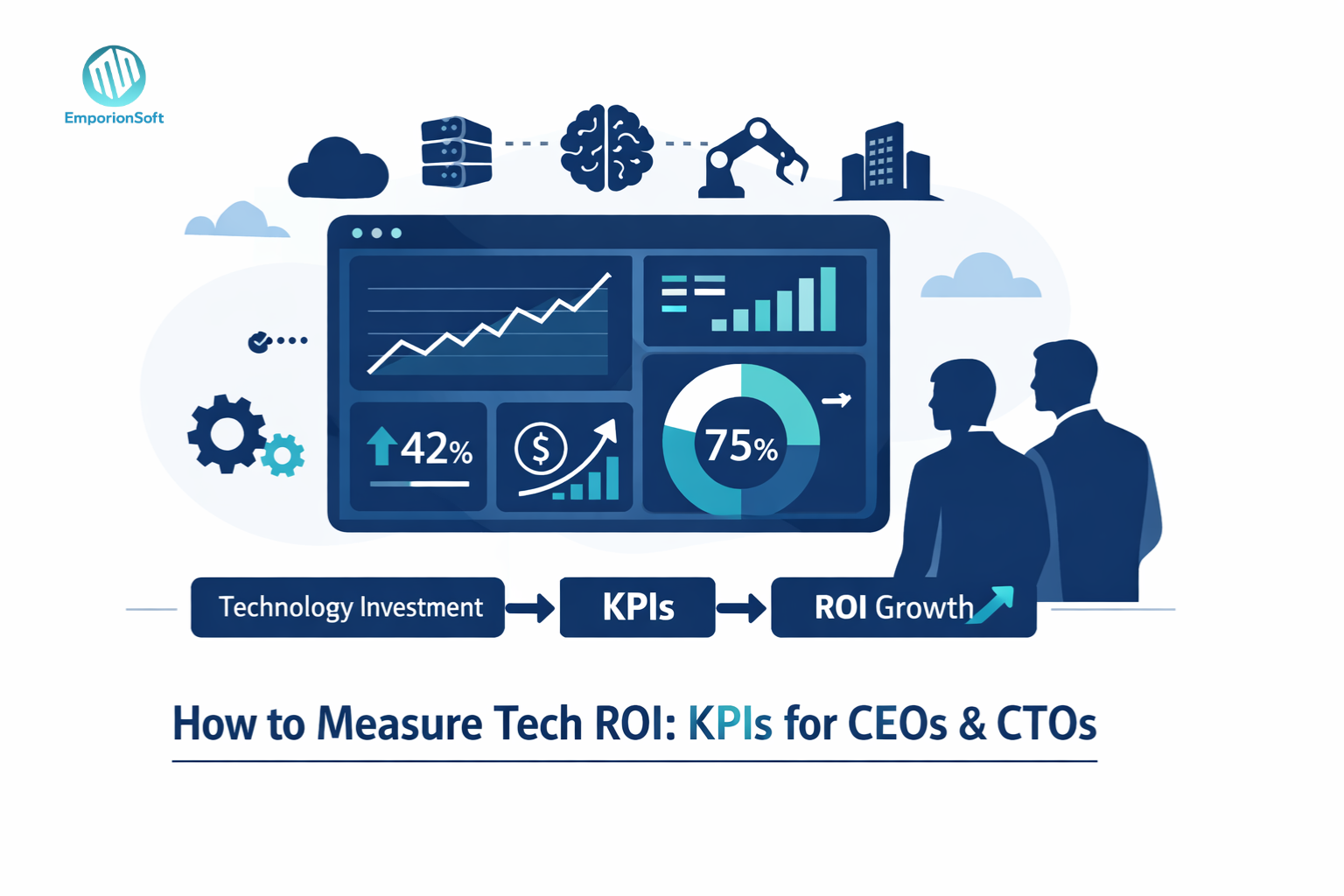
How to Measure Tech ROI: Why It’s Now a Boardroom Imperative
Technology spending has quietly become one of the largest balance-sheet commitments for modern organisations. Yet many leaders still struggle to answer a simple question with confidence: Is our technology actually paying off? In 2026, intuition is no longer enough. Tech ROI metrics have moved from IT dashboards into boardroom conversations, shaping funding decisions, growth strategies, and competitive advantage.
For CEOs and CTOs, measuring the return on technology investments is no longer optional. It is a strategic discipline.
The New Reality of Technology ROI
A decade ago, ROI discussions focused on hardware costs and headcount reduction. Today, investments span cloud platforms, SaaS subscriptions, AI models, cybersecurity, automation, and continuous software upgrades. These initiatives rarely deliver value in neat, linear ways.
This is why measuring ROI for tech investments feels complex, fragmented, and often frustrating.
Traditional financial ROI models struggle to capture outcomes such as faster decision-making, improved developer productivity, reduced technical debt, or enhanced customer experience. Yet these outcomes directly influence revenue, resilience, and scalability.
This gap between spend and insight is where Tech ROI metrics become essential.
What Are Tech ROI Metrics?
At their core, Tech ROI metrics are structured indicators used to evaluate whether technology investments generate measurable business value. They go beyond basic cost-versus-revenue calculations.
Modern technology investment ROI metrics consider financial returns, operational efficiency, risk reduction, and strategic enablement. For example, a cloud migration may not immediately increase revenue. However, it may reduce downtime, improve deployment speed, and enable faster market entry.
When measured correctly, these outcomes translate into long-term value.
Why CEOs and CTOs Struggle With ROI Visibility
Many leadership teams face the same challenges:
-
Technology value is spread across departments
-
Benefits appear over time, not instantly
-
Metrics are owned by IT, not the business
-
Dashboards track activity, not impact
As a result, ROI conversations become reactive. Decisions are driven by urgency rather than evidence.
This is especially risky during digital transformation ROI metrics discussions. Transformation initiatives often fail not because the technology is wrong, but because success was never clearly measured.
From Cost Centres to Value Engines
The most successful organisations have reframed technology from a cost centre into a value engine. They align Tech ROI metrics with business outcomes such as growth, agility, and customer trust.
This shift requires a shared language between technology and leadership.
For instance, instead of asking how much a system costs, executives ask:
-
How does this reduce time-to-market?
-
How does this improve operational resilience?
-
How does this support long-term scalability?
These questions sit at the heart of modern ROI analysis.
Why a Structured ROI Framework Matters
Without a consistent framework, ROI measurement becomes subjective. Teams cherry-pick metrics that support existing decisions. This creates blind spots and misaligned priorities.
A structured approach to Tech ROI metrics allows organisations to:
-
Compare investments objectively
-
Prioritise initiatives with the highest impact
-
Justify budgets with evidence, not assumptions
-
Align IT strategy with business goals
At EmporionSoft, we see this challenge across global projects. Whether organisations are adopting emerging technologies or modernising legacy systems, ROI clarity is the common success factor. Insights shared in our exploration of new technology trends highlight how fast innovation outpaces measurement.
Setting the Stage for Smarter Decisions
This guide is designed to give leaders a practical, executive-level understanding of Tech ROI metrics. It connects financial logic with modern technology realities.
In the sections ahead, we will break down definitions, KPIs, tools, benchmarks, and real-world examples. Each part builds toward a clear goal: helping you measure what truly matters.
Tech ROI Metrics Explained: Foundations Every Leader Must Understand
Before organisations can improve returns, they must first agree on what they are measuring. Many ROI conversations fail because teams use the same words but mean different things. This section establishes a shared foundation for Tech ROI metrics, ensuring clarity for CEOs, CTOs, and CFOs alike.
Clear definitions lead to better decisions.
What Do We Mean by Tech ROI Metrics?
Tech ROI metrics are structured measurements that evaluate the business value created by technology investments. Unlike traditional ROI, they account for both financial and non-financial outcomes.
These metrics answer questions such as:
-
Is this technology improving efficiency?
-
Is it reducing long-term operational risk?
-
Is it enabling future growth?
This broader lens is essential when evaluating modern digital systems.
Core Categories of Technology ROI
Technology value rarely appears in a single number. Effective Tech ROI key performance indicators usually fall into three interconnected categories.
Financial ROI
-
Revenue uplift from new capabilities
-
Cost reduction through automation
-
Lower infrastructure or maintenance spend
Operational ROI
-
Faster deployment cycles
-
Reduced downtime and incident rates
-
Improved team productivity
Strategic ROI
-
Scalability for future growth
-
Faster innovation cycles
-
Reduced technical debt exposure
Leaders who track only financial outcomes miss the bigger picture.
How to Calculate Tech ROI in Practice
At a basic level, the formula for ROI remains familiar:
ROI (%) = (Net Benefit ÷ Total Investment) × 100
However, this formula alone is insufficient for technology initiatives.
To accurately reflect value, organisations must first define “net benefit” clearly. For IT systems, this often includes:
-
Direct revenue gains
-
Cost avoidance
-
Time savings converted into financial value
For example, a platform that reduces release cycles by 30% may not generate revenue directly. Yet it enables faster product launches and quicker market response. That capability has measurable value.
This is why how to calculate tech ROI always starts with aligning metrics to business outcomes.
ROI Metrics for IT Projects and Systems
ROI metrics for IT projects differ from traditional capital investments. Technology assets evolve, integrate, and compound over time.
Common ROI metrics for business technology include:
-
Cost per transaction
-
Time-to-market improvement
-
System availability percentages
-
User adoption rates
When combined, these indicators show whether a system is delivering sustainable value.
Organisations modernising legacy platforms often uncover hidden ROI by addressing technical debt. Our deep dive into technical debt management explains how unmanaged systems silently erode ROI.
Why Qualitative ROI Still Matters
Not every benefit fits neatly into a spreadsheet. Security posture, compliance readiness, and customer trust are difficult to quantify but critical to long-term success.
Ignoring qualitative ROI leads to short-term optimisation and long-term risk.
This is especially true in adaptive environments. As outlined in our guide to adaptive software development, flexibility itself is a form of measurable value.
Building a Shared ROI Language
The most effective organisations use Tech ROI metrics as a common language across leadership, finance, and engineering teams. This alignment reduces friction and accelerates decision-making.
According to Harvard Business Review, organisations that link technology metrics directly to business strategy outperform peers in long-term value creation. This reinforces the importance of moving beyond isolated IT reporting.
Once definitions and calculations are clear, the next challenge emerges. Leaders must decide which metrics matter most at the executive level. That is where KPI frameworks come into play.
Tech ROI KPIs That Matter Most to CEOs, CTOs, and CFOs
Tracking every possible metric creates noise, not insight. Senior leaders need focus. The real challenge is identifying Tech ROI metrics that align with decision-making at the highest level. This section breaks down the KPIs that matter most, based on executive priorities rather than technical activity.
The right KPIs turn data into direction.
Why Executive-Level KPIs Are Different
Operational teams track utilisation, uptime, and velocity. Executives track outcomes. When these perspectives are misaligned, ROI conversations stall.
Effective Tech ROI key performance indicators connect technology performance directly to business impact. They answer one critical question: Is this investment moving the organisation forward?
This distinction is essential for meaningful ROI analysis.
CEO-Focused Tech ROI Metrics
CEOs view technology through the lens of growth, resilience, and competitive advantage.
High-impact Tech ROI metrics for CEOs include:
-
Revenue growth enabled by technology
-
Speed of market entry
-
Customer experience improvements
-
Business scalability indicators
For example, faster product launches supported by modern platforms often correlate with increased market share. These outcomes rarely appear in traditional IT reports, yet they define strategic success.
CTO-Focused Tech ROI KPIs
CTOs are responsible for execution, sustainability, and innovation. Their KPIs focus on how effectively technology enables the organisation.
Key Tech ROI KPIs for CTOs include:
-
Deployment frequency and release stability
-
Infrastructure cost efficiency
-
Technical debt reduction rates
-
Platform reliability and uptime
When tracked consistently, these metrics reveal whether systems are enabling innovation or slowing it down.
Organisations using structured tools for planning and delivery often gain clearer ROI visibility. Insights from modern project management tools for tech companies highlight how governance improves outcome tracking.
CFO-Focused ROI Metrics for Technology
CFOs care about predictability, risk, and financial return. Their perspective anchors ROI discussions in fiscal reality.
Critical Tech ROI metrics for CFOs include:
-
Total cost of ownership
-
Cost savings versus baseline spend
-
Budget variance and forecast accuracy
-
Return timelines
These ROI metrics for enterprise software help finance teams justify ongoing investments while managing exposure.
SaaS, Cloud, and Productivity Metrics
Modern technology stacks require modern KPIs. SaaS tech ROI metrics often focus on:
-
Cost per active user
-
Feature adoption rates
-
Churn reduction
Similarly, Tech ROI metrics for cloud services prioritise:
-
Cost elasticity
-
Resource utilisation efficiency
-
Downtime avoidance
Comparing these against Tech ROI vs productivity metrics helps leaders see whether tools are empowering teams or simply adding complexity.
Our analysis of the future of cloud computing explores how cloud ROI shifts as organisations scale.
Dashboard Metrics That Drive Decisions
Dashboards should simplify, not overwhelm. Effective Tech ROI dashboard metrics present:
-
Trends over time
-
Outcome-based indicators
-
Clear financial and operational links
When KPIs are role-aligned, leadership discussions become faster and more confident.
According to Deloitte, organisations that align technology KPIs with executive objectives are significantly more likely to achieve digital transformation goals. This reinforces the importance of choosing fewer, better metrics.
With the right KPIs defined, the next step is applying them correctly across different technologies. ROI measurement changes depending on whether the investment is SaaS, AI, cloud, or automation.
Tech ROI Metrics by Technology Type: One Size Never Fits All
Not all technology investments behave the same way. Measuring ROI for a CRM system is very different from evaluating an AI model or a cloud migration. This is why applying generic formulas often produces misleading results. Effective Tech ROI metrics must adapt to the technology category being assessed.
Context is everything.
SaaS Tech ROI Metrics
SaaS platforms dominate modern tech stacks, yet their ROI is frequently misunderstood. Subscription pricing hides long-term costs and value.
Key SaaS tech ROI metrics include:
-
Cost per active user
-
Feature adoption rate
-
Process time reduction
-
Customer or employee retention impact
High adoption often signals value, but only when tied to measurable outcomes. A tool used daily but delivering no efficiency gains still erodes ROI.
Tech ROI Metrics for AI and Machine Learning
AI investments promise transformative gains, but their ROI takes time to materialise. Leaders must track progress beyond early experimentation.
Important Tech ROI metrics for AI adoption include:
-
Accuracy improvement over baseline
-
Decision time reduction
-
Cost avoidance through automation
-
Model performance stability
For ROI metrics for machine learning investments, data quality and retraining costs are equally important. A high-performing model today may underperform tomorrow without proper governance.
Our exploration of AI-driven software development shows how ROI improves when AI is embedded into workflows, not isolated pilots.
Cloud Migration and Infrastructure ROI
Cloud projects often promise savings but deliver value through flexibility rather than pure cost reduction. Measuring success requires a broader lens.
Effective ROI metrics in cloud migration projects include:
-
Infrastructure cost elasticity
-
Downtime reduction
-
Deployment speed improvements
-
Scalability without capital expenditure
Tech ROI metrics for cloud services should reflect business agility. Faster scaling during peak demand often outweighs marginal cost increases.
Insights from our work on real-time AI in production demonstrate how cloud-native design amplifies long-term ROI.
Automation Tools and Process ROI
Automation investments deliver some of the clearest ROI when measured correctly. However, over-automation can introduce hidden complexity.
Key Tech ROI metrics for automation tools include:
-
Hours saved per process
-
Error rate reduction
-
Cycle time improvement
-
Cost per transaction
The most valuable automation targets repetitive, high-volume tasks. Automating unstable processes often reduces ROI.
Looking Ahead: Tech ROI Metrics Examples 2026
By 2026, ROI measurement is shifting toward outcome-based analytics. Forward-looking Tech ROI metrics examples 2026 include:
-
AI-assisted productivity uplift
-
Time-to-insight reduction
-
Platform reuse rates
-
Sustainability and energy efficiency metrics
These indicators reflect how technology supports long-term competitiveness.
According to MIT Sloan research, organisations measuring technology ROI by outcomes rather than outputs achieve stronger financial performance over time. This trend reinforces the need for adaptive metrics.
Once metrics are defined by technology type, leaders face another challenge. They must choose the right tools and dashboards to track them effectively, without overwhelming teams or budgets.
Tools, Dashboards, and Low-Cost Ways to Measure Tech ROI Metrics
Measuring ROI is only effective when the data is visible, trusted, and easy to interpret. Many organisations fail here, not because metrics are wrong, but because tools are fragmented or overly complex. The right platforms turn Tech ROI metrics into daily decision assets rather than quarterly reports.
Simplicity drives adoption.
Choosing the Right Tech ROI Measurement Tools
There is no universal tool for ROI measurement. The best choice depends on company size, tech maturity, and budget.
Leading categories of best tech ROI measurement tools include:
-
Financial analytics platforms
-
Product and usage analytics tools
-
Cloud cost management solutions
-
Business intelligence dashboards
For executives, the goal is not more data. It is clearer insight into value creation.
Tech ROI Metrics Tools Comparison by Business Size
A practical Tech ROI metrics tools comparison helps organisations avoid overspending while maintaining visibility.
Enterprise-level tools
-
Integrated ERP and BI platforms
-
Advanced cloud cost optimisation tools
-
Custom executive dashboards
Mid-market solutions
-
SaaS analytics platforms
-
Project ROI tracking tools
-
Cloud-native BI systems
Startup and SMB-friendly tools
-
Spreadsheet-based ROI templates
-
Usage analytics tools
-
Lightweight BI dashboards
These options support Tech ROI metrics for small business without requiring heavy investment.
Building Effective Tech ROI Dashboards
Dashboards should tell a story. They must highlight outcomes, not just activity.
High-impact Tech ROI dashboard metrics include:
-
Trends over time, not snapshots
-
Financial and operational metrics together
-
Clear links between investment and outcome
Avoid vanity metrics. If a metric does not influence a decision, it does not belong on the dashboard.
Our work with scalable data platforms, explored in data lake-driven development, shows how unified data sources dramatically improve ROI visibility.
Low Cost Tech ROI Measurement That Still Works
Not every organisation needs enterprise tooling. Low cost tech ROI measurement can be highly effective when designed correctly.
Practical approaches include:
-
Defining baseline performance before investment
-
Tracking 3 to 5 outcome-driven metrics
-
Reviewing ROI monthly, not annually
Even simple reporting frameworks can deliver clarity when consistently applied.
Tech ROI Analytics Metrics in Modern Stacks
Modern stacks generate rich data streams. The challenge is integration.
Key Tech ROI analytics metrics often pull from:
-
Usage analytics
-
Cloud billing data
-
Delivery and deployment pipelines
Organisations investing in AI and analytics platforms often see improved ROI reporting maturity. Our insights into LLMOps and model optimisation demonstrate how operational metrics evolve into financial insight.
For teams seeking external perspectives on cost-effective development and ROI alignment, resources such as https://thecodev.co.uk/ offer useful comparative viewpoints.
According to Gartner, organisations that standardise ROI dashboards across departments improve investment decision speed significantly. This highlights the value of consistency over complexity.
With tools and dashboards in place, leaders can move beyond measurement into optimisation. The next step is understanding benchmarks, real-world case studies, and best practices that separate average ROI from exceptional performance.
Tech ROI Benchmarks, Case Studies, and Best Practices That Deliver Results
Measuring ROI in isolation creates false confidence. Without benchmarks, organisations cannot tell whether performance is strong or merely acceptable. Context transforms Tech ROI metrics from internal reports into strategic signals.
Benchmarks reveal where value is truly being created.
Understanding Tech ROI Benchmarks and Metrics
Tech ROI benchmarks and metrics provide reference points based on industry, company size, and technology type. They help leaders answer critical questions:
-
Are our returns aligned with market expectations?
-
Are we underperforming in specific areas?
-
Which investments deserve acceleration or correction?
Benchmarks should guide decisions, not dictate them. Every organisation has unique constraints and goals.
Real-World Tech ROI Metrics Case Studies
Case studies reveal how theory works in practice. Across industries, successful organisations share common patterns.
Tech ROI metrics case studies often highlight:
-
Clear baseline measurement before investment
-
Focus on outcome-driven KPIs
-
Continuous review and adjustment
For example, startups tracking Tech ROI metrics for startups often prioritise speed, user adoption, and burn efficiency. Enterprises, by contrast, focus on resilience, scalability, and risk reduction.
Insights from our global delivery work are reflected in EmporionSoft case studies, where ROI clarity played a decisive role in long-term success.
Best Practices for Tech ROI Reporting
Effective reporting turns metrics into action.
Proven best practices for tech ROI reporting include:
-
Aligning metrics with strategic objectives
-
Limiting reports to decision-relevant KPIs
-
Reviewing ROI at regular intervals
-
Sharing insights across leadership teams
Transparency builds trust and accelerates alignment between technology and business functions.
A Practical Tech ROI Metrics Checklist
A simple checklist helps maintain consistency.
Tech ROI metrics checklist:
-
Defined investment objectives
-
Baseline performance recorded
-
Financial and non-financial metrics selected
-
Ownership assigned for each KPI
-
Regular review cadence established
This approach supports ROI metrics for enterprise tech spending while remaining adaptable.
ROI Metrics for Small Business and Enterprises
Smaller organisations often assume ROI frameworks are too complex. This is rarely true.
Tech ROI metrics for small business focus on:
-
Cash flow impact
-
Time savings
-
Customer acquisition efficiency
Enterprises prioritise:
-
System resilience
-
Compliance readiness
-
Portfolio-level ROI visibility
Both benefit from the same principles, scaled appropriately.
Our broader analysis on evolving software practices, available in EmporionSoft insights, shows how maturity in ROI reporting correlates with sustained growth.
According to the World Economic Forum, organisations that benchmark digital investments outperform peers during economic uncertainty. This reinforces the value of external perspective.
With benchmarks and best practices established, leaders are ready for the final step. They must turn insight into strategy, improve ROI continuously, and ensure future technology investments deliver measurable value
Turning Tech ROI Metrics into Strategy, Growth, and Confident Decisions
Measuring technology ROI is not the finish line. It is the starting point for smarter strategy. Organisations that consistently outperform competitors use Tech ROI metrics as a living system, not a static report. They review, refine, and act on insights continuously.
This is where measurement becomes momentum.
Building a Sustainable Tech ROI Metrics Strategy
A strong Tech ROI metrics strategy connects investment decisions to long-term business outcomes. It aligns leadership, finance, and engineering around shared goals.
Effective strategies focus on:
-
Fewer, high-impact metrics
-
Clear ownership and accountability
-
Regular review cycles
-
Alignment with business priorities
This approach ensures ROI discussions remain proactive rather than reactive.
How to Improve Tech ROI Metrics Over Time
Improvement begins with discipline. Organisations that excel at ROI treat measurement as an evolving capability.
Practical ways to improve tech ROI metrics include:
-
Replacing vanity metrics with outcome-driven KPIs
-
Updating baselines after major changes
-
Comparing performance against benchmarks
-
Reviewing assumptions behind each metric
As technologies mature, so should the metrics used to evaluate them.
How to Track Tech ROI Metrics Effectively
Tracking ROI requires consistency and clarity.
To track Tech ROI metrics effectively:
-
Integrate data from finance, operations, and delivery tools
-
Use dashboards designed for decision-makers
-
Review metrics monthly, not annually
This approach supports measuring ROI of software upgrades and ongoing optimisation.
ROI Metrics for Emerging and Advanced Technologies
Emerging technologies introduce new measurement challenges.
Key ROI metrics for emerging technologies include:
-
Time-to-value
-
Adoption velocity
-
Operational risk reduction
-
Strategic optionality
For advanced use cases, Tech ROI metrics for AI adoption, ROI metrics for machine learning investments, and Tech ROI metrics for IoT deployment focus heavily on scalability and sustainability rather than short-term gain.
From Metrics to Meaningful Outcomes
The most successful organisations use ROI insights to prioritise initiatives, allocate budgets, and retire underperforming systems. This clarity transforms technology from an expense into a growth enabler.
At EmporionSoft Pvt Ltd, we help organisations design, build, and optimise technology with measurable value at the core. From ROI-driven software development to digital transformation and enterprise strategy, our approach ensures technology investments deliver outcomes that matter.
If your organisation is investing in complex technologies but lacks clear ROI visibility, now is the time to act.
Speak with our experts to build a technology strategy grounded in measurable impact.
Start your journey with a tailored consultation at https://emporionsoft.com/consultation/ or reach out directly via https://emporionsoft.com/contact-us/.
When technology decisions are guided by the right metrics, confidence follows