
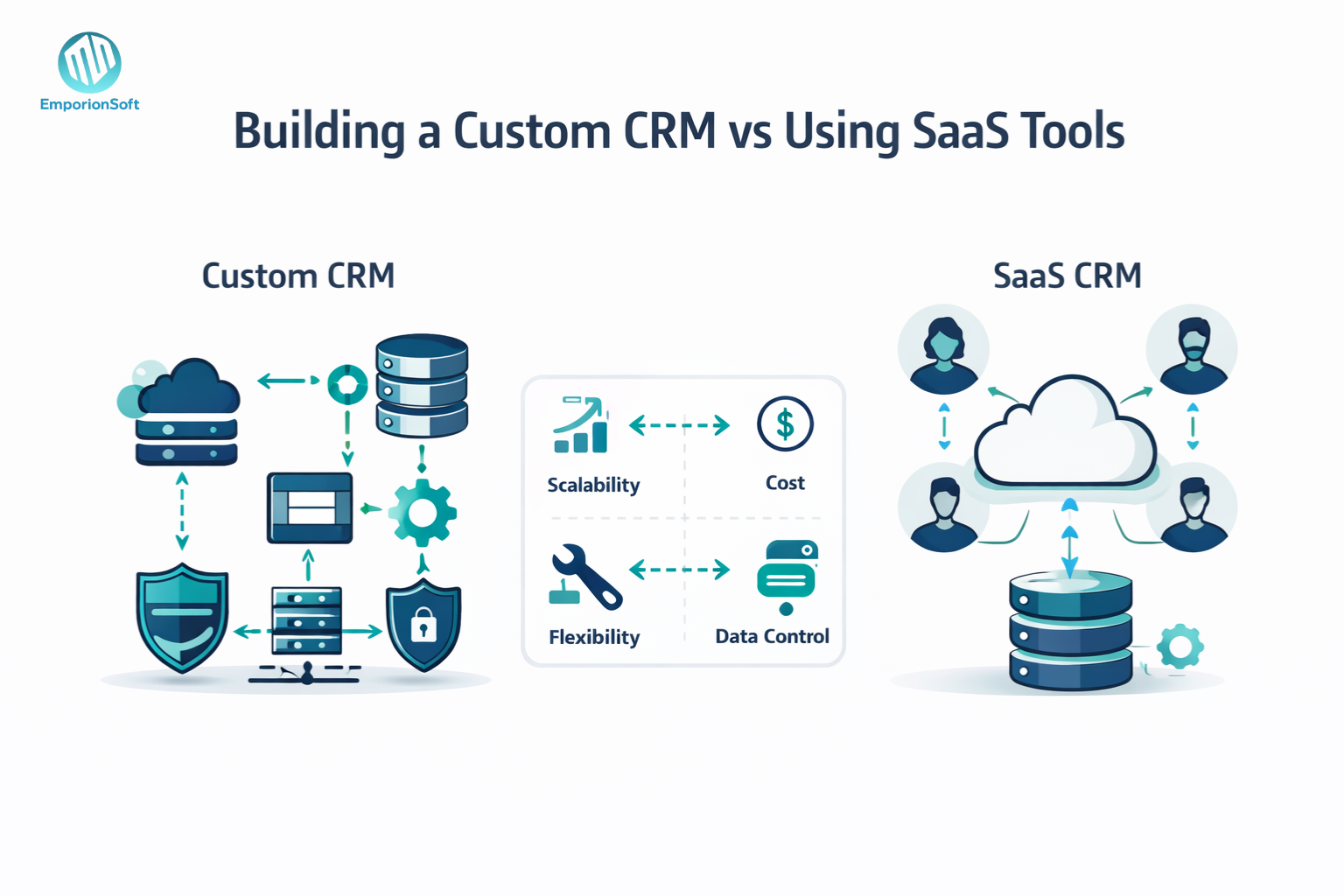
Building a Custom CRM vs Using SaaS Tools: Why This Decision Matters More Than Ever
Choosing the right CRM often feels like choosing a long-term business partner.
One wrong move can slow growth, fracture data, and frustrate teams.
That is why Custom CRM vs SaaS has become a critical boardroom conversation.
As businesses scale, customer data multiplies, processes mature, and compliance pressures rise.
What worked at ten employees may collapse at one hundred.
This is where the difference between custom CRM and SaaS CRM becomes impossible to ignore.
Some organisations thrive on ready-made platforms.
Others outgrow them faster than expected.
Understanding why is the first step toward a smarter CRM investment.
Custom CRM vs SaaS: A Strategic Crossroads for Growing Businesses
CRM software is no longer just a sales tool.
It now sits at the centre of operations, analytics, marketing, and support.
The debate around Custom CRM vs SaaS is not about features alone.
It is about control, adaptability, and long-term cost efficiency.
Off-the-shelf tools promise speed and simplicity.
Custom-built platforms promise precision and ownership.
Both sound attractive, yet they serve very different business realities.
For UK-based and global organisations alike, this choice influences how securely data is stored, how easily systems integrate, and how confidently teams can scale.
Why CRM Decisions Are Becoming More Complex
The modern digital ecosystem is crowded.
CRMs must now integrate with AI tools, analytics platforms, ERP systems, and cloud infrastructure.
This complexity exposes a clear divide between custom CRM vs off the shelf CRM solutions.
SaaS CRMs are designed for the average user.
They prioritise standardisation over specialisation.
That trade-off becomes visible as workflows grow unique.
By contrast, an in-house solution is built around real operational needs.
This is why many leaders now compare SaaS CRM vs in house CRM models earlier in their growth journey.
According to Gartner, CRM adoption failures often stem from poor process alignment rather than missing features.
That insight alone reshapes how this decision should be approached.
Source: https://www.gartner.com/en/sales/insights/customer-relationship-management
The Rising Demand for Ownership and Data Control
Data has become a business asset, not just a by-product.
Where it lives and who controls it matters.
SaaS platforms typically store data on shared cloud infrastructure.
That can raise concerns around compliance, latency, and access control.
These concerns intensify for regulated industries and enterprises.
A custom-built CRM allows full visibility into data flows.
It also supports tailored security models and regional compliance requirements.
This is one reason why global software teams increasingly explore custom solutions alongside cloud strategies.
EmporionSoft’s insights on cloud evolution explain this shift clearly.
https://emporionsoft.com/future-of-cloud-computing/
Why This Guide Exists
Many blogs oversimplify this topic.
They frame it as flexibility versus convenience.
The reality is far more nuanced.
This guide breaks down Custom CRM vs SaaS across cost, scalability, security, and long-term value.
It is written for founders, CTOs, and decision-makers who need clarity, not marketing noise.
Throughout this guide, we will explore practical scenarios, real constraints, and growth-stage decisions.
We will also reference proven engineering perspectives drawn from real-world software delivery.
For deeper technical perspectives on sustainable systems, EmporionSoft regularly shares expert analysis here:
https://emporionsoft.com/our-insights/
Industry leaders like HubSpot also highlight how CRM needs evolve as companies mature.
The question is no longer which CRM is popular.
The real question is which CRM will still serve your business three years from now.
That is where the Custom CRM vs SaaS conversation truly begins.
What Is the Difference Between Custom CRM and SaaS CRM?
At first glance, all CRM systems appear similar.
They store contacts, track sales, and manage customer interactions.
The real distinction emerges when you examine how they are built, owned, and evolved.
Understanding the difference between custom CRM and SaaS CRM helps businesses avoid costly misalignment later.
This section breaks both models down in practical, business-first terms.
What Is a Custom CRM?
A custom CRM is purpose-built software designed around your organisation’s workflows.
It is developed specifically for your teams, processes, and long-term goals.
Unlike ready-made platforms, a custom CRM adapts to the business.
The business does not adapt to the software.
This approach is often described as custom built CRM vs SaaS, because ownership sits entirely with the company.
You decide how data is stored, how features evolve, and how integrations work.
Key characteristics of a custom CRM include:
-
Full ownership of source code and data
-
Tailored workflows aligned with real operations
-
Custom integrations with internal systems
-
Freedom to scale features without licensing limits
This is why many growing organisations evaluate custom CRM vs ready made CRM earlier than expected.
When processes are unique, standardisation becomes a bottleneck.
For businesses embracing adaptive development models, custom systems often deliver greater long-term stability.
EmporionSoft explores this mindset in depth here:
https://emporionsoft.com/adaptive-software-development/
What Is a SaaS CRM?
A SaaS CRM is a cloud-based subscription platform.
It is built for mass adoption and rapid onboarding.
These tools are hosted and maintained by third-party vendors.
Users access them through browsers or APIs, usually with monthly or annual fees.
SaaS platforms shine in speed and accessibility.
They are ideal for teams needing immediate functionality without development overhead.
However, SaaS CRMs are designed around common use cases.
Customisation exists, but within strict boundaries.
This is where the SaaS CRM vs in house CRM debate becomes relevant.
As businesses mature, rigid frameworks can restrict innovation.
Typical SaaS CRM characteristics include:
-
Shared cloud infrastructure
-
Predefined feature sets
-
Limited control over data architecture
-
Ongoing per-user licensing costs
Many SaaS tools also rely on third-party plugins for advanced workflows.
Over time, this can increase complexity rather than reduce it.
Custom CRM vs Cloud-Based CRM: Clearing the Confusion
A common misconception is that custom CRMs are not cloud-based.
In reality, many modern custom solutions are cloud-native.
The real comparison is custom CRM vs cloud based CRM ownership models.
Cloud hosting does not automatically mean SaaS dependency.
A custom CRM can run on private or hybrid cloud infrastructure.
This provides scalability without surrendering control.
EmporionSoft’s perspective on evolving cloud architectures explains this distinction clearly:
https://emporionsoft.com/future-of-cloud-computing/
Ownership, Control, and Strategic Fit
The core difference between these models is ownership.
SaaS users rent functionality.
Custom CRM owners build assets.
With SaaS, feature roadmaps belong to vendors.
With custom systems, roadmaps align with business strategy.
This distinction becomes critical when integrating advanced analytics, AI workflows, or proprietary processes.
External research from McKinsey reinforces how platform ownership impacts digital maturity.
https://www.mckinsey.com/capabilities/mckinsey-digital/our-insights
Some companies thrive on SaaS simplicity.
Others outgrow it quietly, then suddenly.
Understanding this foundational difference sets the stage for deeper comparisons around cost, scalability, and performance.
That is where the Custom CRM vs SaaS discussion truly becomes strategic rather than technical.
Custom CRM vs SaaS Cost Comparison: What Are You Really Paying For?
Cost is often the deciding factor in CRM selection.
Yet many businesses only see the surface numbers.
The true comparison between Custom CRM vs SaaS costs unfolds over time.
Upfront pricing tells one story.
Long-term ownership tells another.
Understanding both prevents expensive surprises later.
Upfront Costs: Build vs Subscribe
SaaS CRMs are attractive because of low entry costs.
Most platforms charge per user, per month.
This makes budgeting feel predictable at the start.
Custom CRM development requires higher upfront investment.
Costs include design, development, testing, and deployment.
For many teams, this initial spend feels intimidating.
This contrast fuels the custom CRM development vs SaaS pricing debate.
Short-term affordability often wins early decisions.
However, upfront cost alone rarely reflects total value.
Hidden Costs of SaaS CRM Platforms
As teams grow, SaaS expenses scale aggressively.
Each new user increases recurring fees.
Advanced features often require premium plans.
Over time, organisations also pay for:
-
Add-on integrations
-
API access limits
-
Third-party plugins
-
Data storage upgrades
These costs rarely appear in early projections.
This is where custom CRM long term cost vs SaaS becomes clearer.
Forrester research shows that subscription software can exceed initial estimates by over 40 percent within three years.
Source: https://www.forrester.com/bold/
Long-Term Economics of a Custom CRM
A custom CRM has a different cost curve.
Investment happens early, then stabilises.
Once built, there are no per-user fees.
No forced upgrades.
No feature gating.
Maintenance costs exist, but they are predictable.
They often scale with business value, not headcount.
This model supports sustainable growth.
It also reduces technical debt when designed correctly.
EmporionSoft highlights this principle in its analysis of long-term system health:
https://emporionsoft.com/technical-debt-explained-identify-manage-eliminate/
ROI and Strategic Value Over Time
The real question is not cost alone.
It is return on investment.
A custom CRM aligns precisely with workflows.
This improves efficiency, reduces manual work, and accelerates decision-making.
SaaS CRMs may require teams to work around limitations.
Those workarounds cost time and morale.
They also slow innovation.
This leads many leaders to ask, is custom CRM better than SaaS?
The answer depends on growth ambition.
Deloitte’s digital transformation studies show that tailored systems often outperform generic tools at scale.
Source: https://www.deloitte.com/global/en/services/consulting.html
Cost Comparison Summary
When evaluating custom CRM vs SaaS cost comparison, consider more than invoices.
SaaS CRM costs include:
-
Ongoing subscriptions
-
Scaling user fees
-
Feature-based pricing
-
Vendor dependency
Custom CRM costs include:
-
One-time development investment
-
Predictable maintenance
-
Infrastructure costs you control
For businesses planning rapid growth, these differences compound quickly.
Real-world examples across EmporionSoft’s case studies show how early investment reduces long-term spend.
https://emporionsoft.com/case-studies/
Cost clarity sets the foundation for smarter decisions.
Next, scalability and flexibility reveal how each model performs under pressure.
Scalability, Flexibility, and Performance: How Each CRM Handles Growth
Growth is rarely linear.
Teams expand, data volumes spike, and customer journeys become more complex.
This is where the real test of Custom CRM vs SaaS begins.
A CRM that works today must still perform tomorrow.
Scalability and flexibility determine whether it becomes a growth enabler or a silent constraint.
Custom CRM vs SaaS CRM: Scalability Under Pressure
SaaS platforms scale by design.
They add users quickly and handle basic growth well.
For early-stage teams, this is often enough.
Problems emerge when growth is uneven.
Sales may scale faster than support.
Regions may grow at different speeds.
SaaS CRMs scale horizontally, not strategically.
You get more of the same structure, not a smarter one.
This limitation often triggers concerns around custom CRM scalability vs SaaS CRM.
A custom CRM scales with intent.
Modules expand where demand grows.
Infrastructure can be tuned for specific workloads.
This approach supports complex growth patterns without performance degradation.
Flexibility: Adapting to Real Business Processes
Every business evolves differently.
New pricing models, sales motions, and compliance rules appear over time.
SaaS CRMs allow configuration, not reinvention.
Fields can be added, workflows tweaked, and reports adjusted.
Beyond that, flexibility stops.
This is the core issue behind custom CRM flexibility vs SaaS comparisons.
Rigid frameworks force teams to change behaviour instead of software.
A custom CRM mirrors real operations.
Processes are coded, not approximated.
This reduces friction across departments.
EmporionSoft often applies adaptive development principles to support evolving requirements:
https://emporionsoft.com/adaptive-software-development/
Performance at Scale: Speed, Latency, and Reliability
Performance is often overlooked until it degrades.
Slow dashboards and delayed updates erode trust quickly.
SaaS platforms operate on shared infrastructure.
Peak usage by other tenants can affect response times.
Custom performance tuning is rarely available.
This is where custom CRM performance vs SaaS becomes visible.
Dedicated infrastructure ensures consistent speed.
Custom CRMs can prioritise mission-critical operations.
Data queries, reporting engines, and APIs are optimised for actual usage patterns.
EmporionSoft’s work with real-time systems highlights the importance of performance engineering:
https://emporionsoft.com/real-time-ai-in-production/
Integration Capabilities: Plug-Ins vs Native Design
Modern CRMs must integrate with analytics, finance, AI, and operational tools.
SaaS CRMs rely heavily on plugins and middleware.
Each integration adds dependency and cost.
It also increases failure points.
This exposes common SaaS CRM limitations.
Complex workflows become fragile.
A custom CRM integrates natively.
APIs are designed around internal systems.
This improves reliability and data consistency.
Scalable data strategies further amplify this advantage.
EmporionSoft explores this in depth here:
https://emporionsoft.com/harnessing-the-power-of-data-lakes-for-scalable-data-driven-software-development/
Scalability and Flexibility in Summary
When comparing Custom CRM vs SaaS, growth readiness matters.
SaaS CRMs offer:
-
Fast initial scaling
-
Standardised performance
-
Limited flexibility
Custom CRMs offer:
-
Strategic scalability
-
Tailored performance optimisation
-
Full process alignment
As businesses grow more complex, flexibility becomes non-negotiable.
Next, security and data control reveal why many organisations reassess their CRM foundations.
Security, Compliance, and Data Control: Who Really Owns Your CRM?
Security is no longer a backend concern.
It is a board-level priority.
When comparing Custom CRM vs SaaS, data ownership often becomes the tipping point.
Customer data carries legal, financial, and reputational risk.
How it is stored, accessed, and protected matters as much as how it is used.
Custom CRM vs SaaS: Data Ownership and Control
SaaS CRMs operate on vendor-controlled infrastructure.
Your data lives in their environment, under their policies.
Access rules are defined by shared frameworks.
This model works for general use cases.
It becomes restrictive when businesses need fine-grained control.
The custom CRM data control vs SaaS debate centres on visibility.
Custom systems give full oversight of data flows, storage, and permissions.
You decide where data resides.
You define who can access it and how.
This is critical for regulated sectors and enterprises.
Security Architecture: Shared vs Dedicated
SaaS vendors invest heavily in baseline security.
However, their environments are multi-tenant by nature.
Security models are designed for scale, not specialisation.
A custom CRM runs on dedicated infrastructure.
Security controls align with internal risk models.
Encryption, authentication, and monitoring are fully configurable.
This distinction underpins custom CRM security vs SaaS discussions.
One offers standard protection.
The other enables tailored defence strategies.
EmporionSoft explores decentralised identity and secure authentication models here:
https://emporionsoft.com/decentralized-identity-and-authentication/
Compliance and Regulatory Readiness
Compliance requirements continue to expand.
GDPR, data residency laws, and industry standards evolve constantly.
SaaS platforms aim for broad compliance.
They may not address niche or regional regulations effectively.
Custom CRMs adapt faster.
Compliance logic is built directly into workflows.
Auditing becomes simpler and more transparent.
This agility is essential for businesses operating across borders.
UK-based organisations with global reach often find this flexibility decisive.
The UK Information Commissioner’s Office outlines strict expectations around data control.
Source: https://ico.org.uk/for-organisations/
Maintenance, Updates, and Risk Management
SaaS vendors control updates.
Changes may be beneficial or disruptive.
You have limited influence.
This can introduce unexpected training needs or workflow changes.
It also affects uptime planning.
Custom CRM maintenance is deliberate.
Updates occur when business readiness aligns.
Testing happens in controlled environments.
This clarity strengthens custom CRM maintenance vs SaaS advantages.
Risk becomes manageable, not reactive.
EmporionSoft’s perspective on resilient system design reinforces this approach:
https://emporionsoft.com/building-resilient-software-strategies-for-disaster-recovery-and-business-continuity/
Security and Compliance Summary
When evaluating Custom CRM vs SaaS, security is about control, not fear.
SaaS CRMs provide:
-
Vendor-managed security
-
Shared compliance frameworks
-
Limited customisation
Custom CRMs provide:
-
Full data ownership
-
Tailored security architecture
-
Adaptive compliance workflows
As data sensitivity increases, control becomes strategic.
Next, real-world use cases reveal which CRM model fits different business stages.
Custom CRM vs SaaS: Use Cases Across Startups, Scale-Ups, and Enterprises
There is no universal answer to the CRM question.
The right choice depends on business stage, complexity, and growth intent.
That is why real-world custom CRM use cases provide the clearest guidance.
This section breaks down when each model works best.
Custom CRM for Startups vs SaaS: Speed vs Strategic Fit
Early-stage startups prioritise speed.
They need tools that work immediately.
SaaS CRMs often fit this phase well.
With minimal setup, teams can manage leads, pipelines, and customer interactions.
Costs remain manageable at small scale.
However, startups with complex products or regulated markets often hit limits early.
Custom workflows, unconventional pricing models, or deep integrations become difficult.
This is where the custom CRM for startups vs SaaS decision shifts.
Founder-led teams with strong product-market fit may benefit from early customisation.
SaaS works best when:
-
Processes are simple
-
Teams are small
-
Speed outweighs differentiation
Custom CRM works better when:
-
Workflows are unique
-
Data models are complex
-
Long-term scalability is a priority
EmporionSoft’s insights on AI-driven development highlight how early technical decisions shape future agility.
https://emporionsoft.com/how-ai-is-revolutionizing-software-development/
Growing Businesses: Where SaaS Starts to Strain
Scale-ups often feel CRM friction first.
User counts increase.
Departments diversify.
At this stage, businesses ask about the best CRM for growing businesses custom vs SaaS.
SaaS platforms begin to show cracks:
-
Rising subscription costs
-
Workflow constraints
-
Integration sprawl
Teams start building workarounds.
Spreadsheets return.
Data consistency suffers.
Custom CRM adoption often happens here.
It replaces fragmented tools with a unified system.
This transition aligns with broader operational maturity.
EmporionSoft explores tooling alignment for tech companies here:
https://emporionsoft.com/project-management-tools-for-tech-companies/
Custom CRM for Enterprises vs SaaS CRM
Enterprises operate at a different scale entirely.
They manage high data volumes, multiple regions, and strict compliance rules.
SaaS CRMs struggle with:
-
Complex approval chains
-
Custom security models
-
Deep legacy integrations
This is why custom CRM for enterprises vs SaaS CRM comparisons heavily favour bespoke solutions.
Enterprises need:
-
Role-based access control
-
Custom reporting logic
-
Data residency control
A custom CRM becomes a strategic platform, not just software.
It aligns sales, operations, analytics, and compliance into one ecosystem.
This also strengthens custom CRM integration vs SaaS CRM capabilities.
Internal systems connect directly, without brittle plugins.
When to Choose Custom CRM
The question is not whether custom CRM is better.
It is when it becomes necessary.
You should consider custom development when:
-
SaaS limits block growth
-
Data ownership becomes critical
-
Integration complexity increases
-
Subscription costs escalate rapidly
This is the heart of when to choose custom CRM decisions.
Custom systems are not about replacing tools prematurely.
They are about building foundations that support ambition.
Across startups, scale-ups, and enterprises, the pattern is clear.
SaaS accelerates beginnings.
Custom CRM sustains growth.
Custom CRM vs SaaS: Final Verdict and the Smarter Way Forward
By now, one truth should be clear.
The Custom CRM vs SaaS debate is not about right or wrong.
It is about timing, intent, and long-term vision.
Both models solve problems.
They simply solve different ones.
Custom CRM vs SaaS Pros and Cons at a Glance
SaaS CRM platforms excel in accessibility.
They reduce setup time and simplify early operations.
For many teams, that speed is invaluable.
However, SaaS tools trade depth for convenience.
As complexity increases, limitations surface.
This is where custom CRM advantages over SaaS become visible.
SaaS CRM pros include:
-
Fast deployment
-
Lower upfront cost
-
Vendor-managed infrastructure
SaaS CRM limitations include:
-
Rising long-term costs
-
Restricted flexibility
-
Limited data control
Custom CRM pros include:
-
Full ownership and control
-
Tailored workflows
-
Seamless internal integrations
Custom CRM challenges include:
-
Higher initial investment
-
Need for technical partnership
-
Ongoing maintenance planning
This balanced view defines custom CRM vs SaaS pros and cons clearly.
Integration, Ownership, and Strategic Control
Modern businesses rely on interconnected systems.
CRMs must integrate deeply with analytics, finance, AI, and operations.
SaaS platforms rely on external connectors.
These add cost and risk.
Custom systems are designed with integration in mind.
This strengthens custom CRM integration vs SaaS CRM outcomes significantly.
Ownership also changes decision-making.
With SaaS, roadmaps follow vendors.
With custom CRM, roadmaps follow strategy.
This distinction is subtle at first.
It becomes decisive at scale.
So, Is Custom CRM Better Than SaaS?
The honest answer depends on growth ambition.
If your business prioritises speed and simplicity, SaaS delivers value.
If your business prioritises differentiation, scalability, and control, custom CRM wins.
This is why many organisations start with SaaS and evolve toward custom solutions.
It is not a replacement strategy.
It is a maturity strategy.
EmporionSoft has seen this transition repeatedly across industries and regions.
What matters is building systems that support where you are going, not just where you are.
Choosing the Right Partner Matters
A custom CRM is not just software.
It is a long-term digital asset.
Success depends on architecture, scalability planning, and technical leadership.
The wrong implementation creates more problems than it solves.
That is why businesses partner with teams who understand growth, not just code.
EmporionSoft Pvt Ltd is a UK-based software company delivering projects globally.
The team specialises in building scalable, secure, and future-ready software systems.
From CRM platforms to AI-driven applications, solutions are designed around real business needs.
If you are evaluating Custom CRM vs SaaS and want clarity tailored to your organisation, expert guidance makes all the difference.
Let’s Build What Your Business Actually Needs
Whether you are outgrowing SaaS tools or planning a custom CRM from day one, the next step should be informed, not reactive.
Discuss your goals, constraints, and growth plans with a team that builds for the long term.
Explore how EmporionSoft can help you design and develop a CRM that fits your business today and scales confidently into tomorrow.
👉 Start the conversation here:
https://emporionsoft.com/consultation/
https://emporionsoft.com/contact-us/
https://emporionsoft.com/about/
The right CRM is not the most popular one.
It is the one that grows with you.
Custom CRM Implementation Challenges vs SaaS Limitations: What to Expect in Reality
Every CRM decision comes with trade-offs.
Understanding challenges early prevents failed implementations later.
This section addresses custom CRM implementation challenges alongside common SaaS CRM limitations.
Custom CRM Implementation Challenges You Should Plan For
A custom CRM is not a plug-and-play tool.
It is a strategic software initiative.
That reality introduces responsibility.
The most common challenges include:
-
Clear requirement definition
-
Stakeholder alignment across teams
-
Phased rollout planning
-
Ongoing governance and ownership
Without clarity, custom projects can drift.
That risk is real, but manageable.
Successful teams treat CRM development as a product, not a project.
They prioritise iterative delivery and continuous feedback.
EmporionSoft often applies this mindset using adaptive delivery frameworks:
https://emporionsoft.com/adaptive-software-development/
When executed correctly, complexity becomes structured, not overwhelming.
Time-to-Value: Custom CRM vs SaaS
SaaS CRMs deliver faster initial value.
They are operational within days.
This speed is appealing.
Custom CRM timelines are longer.
Design and development take time.
However, that time is invested, not lost.
The trade-off is depth versus immediacy.
SaaS offers quick wins.
Custom CRM offers lasting alignment.
This distinction explains why many businesses delay custom development until SaaS friction becomes visible.
SaaS CRM Limitations That Surface Over Time
SaaS tools rarely fail immediately.
They fail gradually.
Common SaaS CRM limitations include:
-
Feature rigidity
-
Vendor-driven updates
-
Limited custom reporting
-
Scaling costs tied to headcount
Workarounds emerge quietly.
Manual processes return.
Data becomes fragmented.
At this stage, teams often feel locked in.
Migration becomes harder, not easier.
This is why early awareness of SaaS CRM limitations matters.
It allows proactive planning rather than reactive replacement.
Managing Risk Through the Right Technical Partner
Custom CRM success depends heavily on execution quality.
Architecture decisions made early have long-term impact.
Strong partners focus on:
-
Scalable system design
-
Security-by-default architecture
-
Integration-first development
-
Clear documentation and ownership
EmporionSoft’s work in resilient system design highlights how structured planning reduces operational risk:
https://emporionsoft.com/building-resilient-software-strategies-for-disaster-recovery-and-business-continuity/
This approach transforms implementation challenges into controlled milestones.
Challenges as Decision Signals, Not Barriers
Challenges are not warnings to avoid custom CRM.
They are signals to prepare properly.
If your organisation can define processes, commit stakeholders, and think long term, custom CRM becomes an asset.
If speed and simplicity outweigh strategic control, SaaS remains effective.
Recognising these signals early sharpens the Custom CRM vs SaaS decision.
With a clear view of challenges and limitations, the final step is aligning technology choices with business ambition.
Ready to Choose the Right CRM for Your Business?
The Custom CRM vs SaaS decision is not just a technology choice.
It is a growth decision.
If your business is outgrowing off-the-shelf tools, struggling with integrations, or facing rising SaaS costs, it may be time to rethink your CRM strategy.
A well-designed custom CRM can give you control, scalability, and long-term value that generic platforms cannot match.
EmporionSoft Pvt Ltd is a software development company delivering custom solutions for businesses worldwide.
From strategy and architecture to development and long-term support, EmporionSoft builds CRM systems that align with real business processes, not assumptions.
Whether you are:
-
Evaluating custom CRM vs SaaS for the first time
-
Planning to replace a restrictive SaaS CRM
-
Looking for a scalable CRM tailored to your operations
Expert guidance can save you time, cost, and future rework.
👉 Book a consultation to discuss your CRM goals:
https://emporionsoft.com/consultation/
👉 Contact the EmporionSoft team directly:
https://emporionsoft.com/contact-us/
👉 Learn more about EmporionSoft’s expertise:
https://emporionsoft.com/about/
Build a CRM that grows with your business, not against it.