
Logistics App Development in Pakistan: Features, Cost & Real-World Example
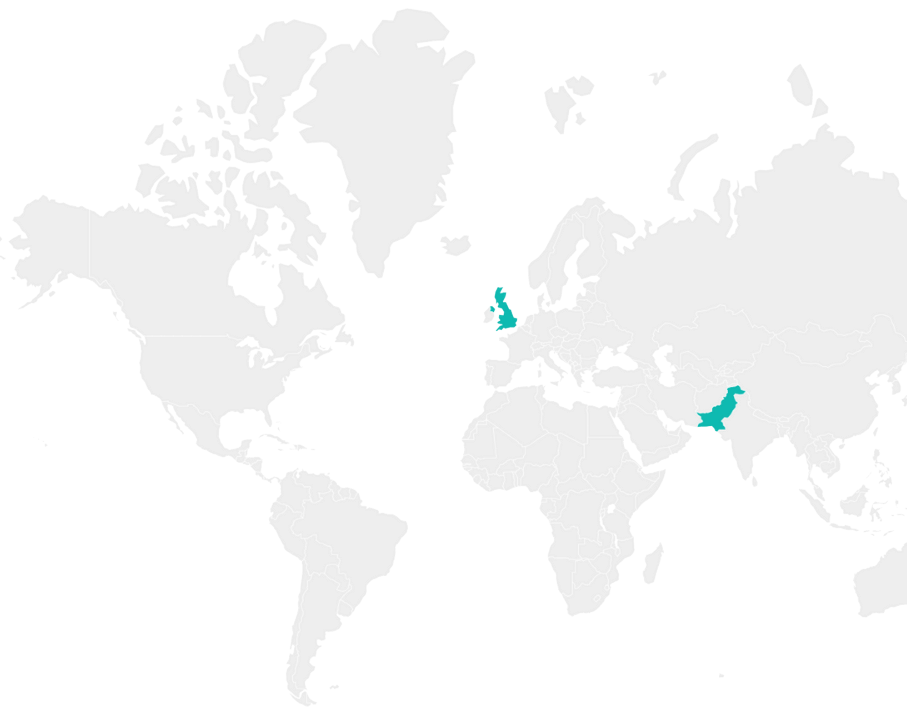
For buyers comparing logistics app opportunities, Pakistan is now a serious market to consider because it offers capable engineering talent, sensible build economics, and strong mobile development depth. This is why the phrase logistics app development Pakistan now reflects a real buyer search, not a niche curiosity.
What logistics app development Pakistan buyers should expect from the market
A founder looking at logistics software in 2026 is rarely asking for a simple tracking app. The real need is broader. Buyers want a product that helps move shipments, coordinate carriers, reduce manual follow up, and create a reliable customer experience without building an oversized platform too early.
Pakistan has become a credible place to build that kind of product for two reasons. First, the local software market is mature enough to support mobile, backend, QA, cloud, and product design as one delivery stream. Second, the cost profile is often more manageable than hiring a full in house product team from day one. That does not mean every project should be outsourced, but it does make Pakistan a practical option for logistics founders and transport businesses that need execution capacity.
EmporionSoft has already covered the strategic case for outsource software development to Pakistan. That context matters here because logistics products are cross functional by nature. A weak team can usually build screens. A capable team can connect customer actions, carrier workflows, payments, status updates, and operations logic into one usable system.
Market readiness also matters. According to the Pakistan Telecommunication Authority annual report release, Pakistan has broad telecom and broadband reach, which supports the practical use of mobile first platforms for drivers, customers, dispatchers, and admin staff. That does not guarantee adoption on its own, but it removes one of the common objections to launching app based operations.
The logistics side of the equation is just as important. The World Bank Logistics Performance Indicators platform frames logistics performance around visibility, quality, efficiency, and reliability. Those same ideas translate directly into software requirements. A logistics product is useful when it improves operational visibility, reduces uncertainty, and helps each user role take the next action with less friction.
For the buyer, this shifts the evaluation question. The question is not only, “Can this team build an app?” A better question is, “Can this team model how shipments move, how carriers are onboarded, how pricing is set, and how exceptions are handled?” That is the difference between a cosmetic product and one that can support real transport operations.
This is also why broad market articles such as Pakistan IT Industry 2026 are relevant, but not sufficient on their own. A logistics build needs industry logic. The product must reflect dispatch realities, route uncertainty, customer expectations, and payment behaviour in markets where trust and communication often decide whether the service feels dependable.
A strong market expectation should therefore include five things:
- product discovery before feature scoping
- multi role workflow thinking, not just one user journey
- realistic cost planning, including maintenance
- mobile and backend architecture that can scale
- proof that the team understands logistics operations, not only app development
That is the baseline. Once that is clear, the next decision is defining the business problem the product should solve.
What problem should a logistics app solve before you build features?
A logistics app should first solve a coordination problem. Before you discuss maps, payments, or dashboards, you need to identify where bookings break down, where shipment visibility gets lost, and where carriers, customers, and operations teams waste time.
Many buyers start with a feature wishlist. That feels efficient, but it usually produces a shallow product. In logistics, features only make sense when they sit inside a workflow. A shipment has to be created, quoted, accepted, assigned, tracked, updated, delivered, and closed. If you do not understand where pain exists in that chain, your feature set becomes expensive decoration.
In most cases, the core business problem falls into one or more of these areas:
- Booking friction
Customers cannot request transport or delivery quickly, or they need too much manual support to do it. - Dispatch inefficiency
Jobs are assigned through calls, messaging apps, or spreadsheets, which slows response time and creates avoidable errors. - Low visibility
Customers and operations teams do not know where a parcel, rider, or vehicle is in real time. - Pricing inconsistency
Quotes vary from one operator to another, or pricing depends too heavily on manual judgment. - Weak trust mechanisms
Carriers are not well verified, payment handling is unclear, and disputes are hard to resolve. - Operational blind spots
Managers lack reporting on completed jobs, failed deliveries, acceptance rates, and fulfilment performance.
This problem first approach is one reason custom software projects vary so much in scope and cost. A simple booking and tracking product is fundamentally different from a marketplace that matches shippers with independent carriers. That distinction is central to cost planning, which is also why custom software development cost in Pakistan is a useful planning reference.
Product architecture matters as well. A parcel delivery app, a freight management platform, and an on demand transport app Pakistan business may all share some technical foundations, but their decision logic is different. A direct courier app may optimise for speed and repeat bookings. A peer to peer logistics model may optimise for bidding, trust, and fulfilment coverage. A fleet focused system may care more about route scheduling, vehicle capacity, and dispatch control.
The safest way to define the problem is to map each actor and their desired outcome. That usually means at least four roles:
- customer or shipper
- carrier, driver, or transport provider
- operations or dispatch
- finance or admin
A clear product brief should answer practical questions for each role. What does the user need to do? What information do they need at that moment? What can go wrong? What should happen next if an action fails? This is where architecture thinking becomes useful, and enterprise architecture patterns provide a helpful lens for structuring roles, events, permissions, and data flows.
If a founder skips this step, the product usually becomes fragmented. The customer app looks polished, but the carrier experience is poor. Or the admin dashboard is too thin, so the team falls back to manual coordination. Or payment logic is added late, causing avoidable rework.
The goal is not to define every edge case upfront. It is to identify the operational problem clearly enough that feature decisions become obvious instead of speculative. Once that is done, you can define the feature set with much more discipline.
What features does a parcel delivery app need in Pakistan?
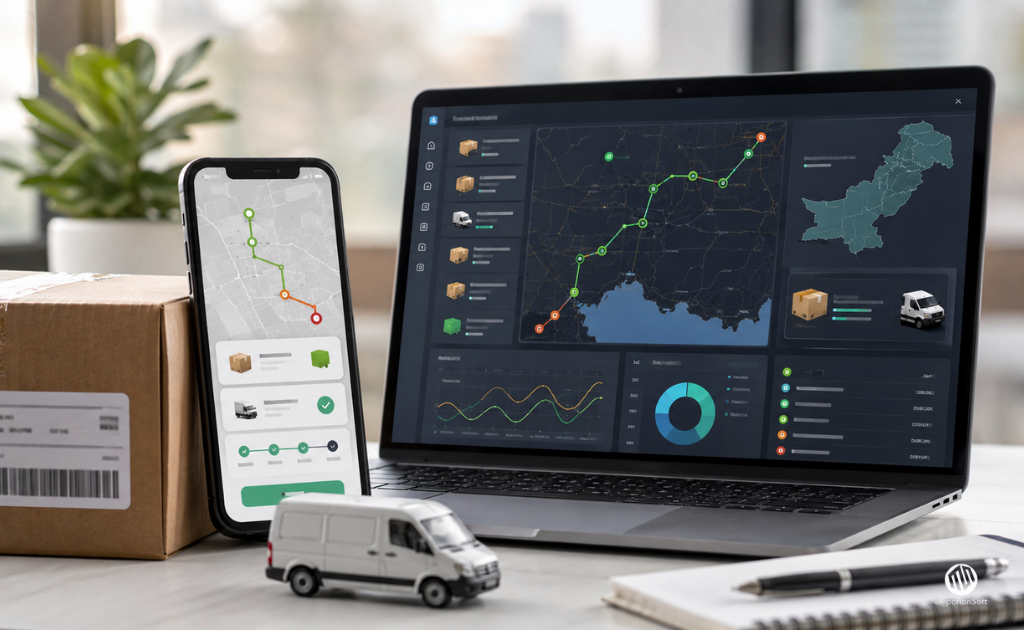
A parcel delivery app needs a role based feature set, not a single generic interface. In practice, that means one experience for customers, one for carriers or drivers, and one for operations staff, all connected through a backend that manages shipment state, communication, and payments.
The most common mistake in parcel delivery app development Pakistan projects is to over focus on the customer app because it is the most visible layer. The customer experience matters, but the platform only works if the carrier workflow and admin controls are equally strong.
A useful way to think about the feature set is by role.
Customer side features
The customer app or web flow usually needs:
- account creation and profile management
- pickup and delivery address entry
- parcel details and category selection
- quote request or instant pricing
- booking confirmation
- real time tracking
- push notifications for status changes
- payment and invoice history
- issue reporting or support chat
For many businesses, this is where the commercial value becomes visible. The app reduces booking friction and makes service status easier to understand. That is part of the wider business case behind mobile apps for operational efficiency and customer engagement.
Carrier or driver side features
The carrier app has different priorities:
- onboarding and document submission
- verification and approval status
- job acceptance or rejection
- bidding, if the model supports it
- route and stop details
- pickup proof and delivery proof
- wallet or payout visibility
- notification centre
- job history and ratings
This is where many marketplace and last mile delivery app development products either succeed or fail. If the workflow is too complex, carriers disengage. If it is too loose, service quality becomes inconsistent.
Operations and admin features
Operations teams need control, not clutter. Core functions usually include:
- shipment monitoring
- manual job assignment
- exception handling
- carrier verification review
- pricing and commission settings
- dispute management
- payment reconciliation
- analytics and reporting
- user management and permissions
The backend architecture behind these features should be planned carefully. Shipment status changes, pricing rules, notification triggers, and payment events all need stable APIs and clear data contracts. That is why scalable APIs for SaaS style platforms are directly relevant to logistics systems.
A simple role summary helps keep scope under control:
| Product area | Must have capability | Why it matters |
|---|---|---|
| Customer experience | Booking, tracking, notifications, payments | Drives trust and repeat usage |
| Carrier workflow | Onboarding, job management, proof, payouts | Determines fulfilment quality |
| Admin operations | Dispatch, verification, disputes, reporting | Keeps the business operational |
| Platform layer | APIs, data model, status engine, alerts | Connects all moving parts |
Feature priority should also reflect the business model. A supply chain app Pakistan platform that serves business accounts may need stronger dashboards and invoicing. A carrier app development Pakistan project may prioritise onboarding and dispatch speed. A peer to peer logistics product may need bidding and escrow style payment logic.
The right feature list is not the longest one. It is the smallest complete set that supports a real shipment journey from booking to delivery without forcing the operations team back into manual work.
How much does courier app development cost in Pakistan?
Courier app development cost in Pakistan depends less on screen count and more on workflow complexity. A narrow MVP can be relatively affordable, but a multi role logistics platform with tracking, bidding, payments, and admin controls requires a larger investment because it is effectively a connected operating system, not a brochure app.
A useful way to think about cost is by product stage, not by a single flat quote. Founders often ask for “the app cost,” but there are usually three different budgeting questions hiding underneath that request:
- What does it cost to validate the idea with a lean MVP?
- What does it cost to launch a usable business platform?
- What does it cost to build a more scalable marketplace product?
For planning purposes, the Pakistan market often falls into broad ranges like these. These are directional estimates, not fixed market prices, and the exact number will depend on the team structure, integrations, design depth, testing scope, and support model.
| Build level | Typical scope | Indicative timeline | Indicative budget range |
|---|---|---|---|
| Lean MVP | Customer app, carrier app, basic admin, booking, status updates | 10 to 16 weeks | PKR 3 million to 6 million |
| Operational launch build | Stronger admin, payments, notifications, reporting, verification | 4 to 6 months | PKR 6 million to 12 million |
| Advanced logistics marketplace | Bidding, richer analytics, multi currency, complex payouts, scaling support | 6 months and beyond | PKR 12 million and above |
These ranges line up with the broader planning logic discussed in mobile app development cost in Pakistan 2026, but logistics products deserve a narrower lens because their operational logic is more demanding than many standard app categories.
Several variables drive the final number.
1. Number of user roles
A single customer app is much cheaper than a platform with customer, carrier, admin, and finance workflows. Every additional role increases both design and testing effort.
2. Tracking and mapping depth
Basic location display is one thing. Route intelligence, shipment event logic, and real time location accuracy are another. Maps, geolocation, and route services can increase both engineering and third party service costs.
3. Payment complexity
A standard checkout flow is simpler than a marketplace payout structure. If the platform needs to collect payment, hold platform fees, and distribute earnings to carriers, backend and compliance complexity rises.
4. Reporting and operations tools
Operations teams often need custom dashboards, filters, exports, exception queues, and reconciliation views. These are not cosmetic extras. They often determine whether the system reduces manual work.
5. QA and rollout quality
A logistics app is hard to test casually. You need scenario testing across roles, devices, notifications, and edge cases such as failed pickups, rejected bids, duplicate bookings, and partial deliveries.
The post launch budget matters too. Founders who only budget for the first release usually underestimate what it takes to stabilise the product after users arrive. Maintenance includes bug fixing, cloud costs, support, updates, and iterative improvement, which is why app maintenance costs should be part of the original business case, not an afterthought.
A practical buyer mindset is to treat cost as a scope decision. The better question is not “What is the cheapest app I can build?” It is “What is the smallest complete product that can run the operation credibly?”
Where logistics apps fail after launch and how to reduce the risk
Most logistics apps fail after launch for operational reasons, not visual ones. The interface may look polished, but the product breaks when real shipments, real carriers, and real exceptions start moving through the system.
One of the biggest failure points is inaccurate or delayed status handling. If customers see the wrong shipment status, trust falls quickly. If drivers or carriers cannot update events easily, the system becomes stale. That is especially dangerous in a product built around real time tracking, because users assume the app reflects reality.
Another common failure point is weak carrier onboarding. Many founders assume that once the app exists, carriers will use it correctly. In practice, onboarding needs structure. The app has to support document collection, profile review, approval states, and ongoing trust signals. Without that, the product may attract users but still fail to deliver reliable service.
Payment workflows are another risk area. A logistics app that supports direct booking may only need standard payment collection. A marketplace or peer to peer logistics app development model can be more complex. You may need to collect funds, apply platform fees, track payouts, and handle disputes. If this logic is vague, commercial friction appears fast.
Notification design is often underestimated too. Push notifications should not be treated as a cosmetic add on. Shipment booked, carrier assigned, parcel picked up, delivery attempted, and payment received are all operational events. If alerts arrive late or without useful context, users fall back to calls and messaging, which undermines the product’s value.
Several practical controls reduce these risks:
- Test workflows, not just screens
A button can work while the business flow still fails. Testing should cover full journeys across all roles. - Model exceptions early
Failed pickups, wrong addresses, late arrivals, rejected bids, and proof mismatches are not edge cases. They are routine operating scenarios. - Launch with a support process
Even a well built product needs manual support pathways during early usage. - Instrument the platform
Track acceptance rates, fulfilment times, failed delivery reasons, and notification success, not just app downloads. - Use staged rollout logic
It is usually safer to launch in one city, corridor, or service type before expanding.
This is where disciplined engineering and QA start paying off. The principles behind shift left testing are useful because they push the team to identify quality issues earlier, when they are cheaper to fix. The same applies to execution capability. A logistics platform is a good example of why QA testing in Pakistan is not a side service but part of the product’s economic success.
Security and privacy should also be handled with care. Delivery platforms can involve user identities, addresses, transaction data, and operational movement data. You do not need to turn an early stage product into a compliance heavy enterprise suite, but you do need sensible access control, secure credential handling, auditability, and payment discipline. If the platform crosses multiple jurisdictions or payment rails, confirm the legal specifics with qualified local advisers.
A logistics product does not earn trust because it has every feature. It earns trust because each event, handoff, and status change behaves predictably under real operating pressure.
Which technology stack makes sense for a logistics platform?
A sensible logistics stack usually combines cross platform mobile delivery, a stable backend, a clear database model, cloud infrastructure, third party mapping services, notifications, and payment services. The right stack is the one that supports shipment workflows cleanly and can evolve without forcing a rebuild too early.
For many projects, a practical mobile choice is React Native. It allows teams to build for iOS and Android from a shared codebase while still using native capabilities where needed. That makes it a strong option when the product needs customer and carrier apps, especially if budget discipline matters.
Backend choice depends on the product model, but Node.js is a common fit for event driven, API centric platforms with frequent status updates and notification triggers. It works well for products where booking events, tracking updates, pricing rules, and admin actions all need to be processed quickly and consistently.
This is also why the framework choice discussion in React Native vs Flutter Pakistan 2026 can help founders ask better questions. The framework is not only a developer preference issue. It affects hiring, iteration speed, plugin maturity, and long term maintenance.
A typical logistics platform stack might look like this:
- React Native for customer and carrier mobile apps
- Next.js or a modern web stack for admin portals
- Node.js or NestJS style backend services
- PostgreSQL or another relational database for shipment, payment, and user records
- Redis or queue tooling for background jobs and notifications
- cloud object storage for proof of pickup and delivery assets
- push notification services for shipment events
- payment infrastructure for collection and payouts
The mapping layer deserves special attention. Real time tracking app development Pakistan projects often treat maps as a front end concern, but route and distance logic can influence pricing, dispatching, ETA handling, and service zones. Google Maps Platform Route Optimization is one example of a service that can support route planning needs when the use case goes beyond simply showing a pin on a map.
Notifications also need deliberate design. Firebase Cloud Messaging is a common choice for push delivery, but the technical service alone is not enough. You still need event logic, retry handling, and meaningful message content.
For payments, marketplace style builds often need more than a one step checkout. If the business model involves collecting customer funds and paying carriers later, tools such as Stripe Connect illustrate how platform based payments can be structured. The exact provider choice depends on market availability and the countries where the service operates.
Data design is equally important. Logistics platforms generate interconnected records: shipments, addresses, bids, users, proofs, payouts, and status events. Founders often ask whether SQL or NoSQL is better, but the better discussion is about consistency, querying needs, and reporting depth. For most shipment and transaction heavy products, SQL vs NoSQL database tradeoffs should be reviewed in operational terms rather than trend terms.
A good stack decision does not aim for novelty. It aims for clarity. If the stack helps the team ship reliably, observe the platform, and improve it without major architectural friction, it is usually the right one.
What a real logistics app example teaches about product execution
A real logistics app example is useful because it turns abstract product advice into a sequence of build decisions. In that sense, ECOURI matters less as a label and more as proof that a logistics product can be structured around real operational needs instead of generic app assumptions.
The strongest lesson from a product like ECOURI is that logistics software is usually a multi sided system. It is not just an app for customers who want a parcel moved. It also has to work for carriers who accept work, operations teams who supervise service quality, and administrators who manage risk, payments, and platform health.
That changes execution in several ways.
1. The marketplace logic has to be intentional
If the product supports multiple carriers, bidding, or flexible fulfilment models, the marketplace rules need to be defined early. Who sees a job first? How long do they have to respond? Can the customer compare offers? What happens if a carrier accepts and then drops the task? These are product rules, not minor settings.
2. Trust features matter as much as core booking flows
Carrier verification, profile completeness, job history, proof handling, and controlled payout logic are not optional extras. They shape whether the platform feels safe enough for repeat use. In many logistics products, trust is the feature that determines growth.
3. The admin layer is where business control lives
A team can build a clean customer app and still fail operationally if the admin system is too thin. Shipment oversight, support handling, dispute review, manual intervention, and reporting all need usable internal tools. This is one reason logistics founders should review a vendor’s broader case studies instead of looking only at polished front end examples.
4. Execution quality depends on service integration discipline
Real products have to connect mobile apps, APIs, location services, notifications, payment flows, and reporting. That usually requires a development partner with end to end capability across product design, engineering, and backend architecture, not only a mobile app team. EmporionSoft’s services overview is relevant here because logistics builds often span several delivery disciplines at once.
5. The real value is operational coherence
A logistics app becomes commercially useful when each role sees the right information at the right time. Customers need visibility. Carriers need usable task flows. Operations teams need exception handling. Finance needs payout clarity. When those pieces align, the software becomes part of the business model, not just an interface layer.
A practical product like ECOURI also highlights an important scope discipline point. Founders do not need every logistics feature from day one. What they need is a coherent first release. That might mean:
- quote request plus booking
- carrier onboarding and approval
- job assignment or bidding
- shipment lifecycle tracking
- secure payment handling
- admin oversight and reporting
That is enough to prove whether the workflow works in the market. Expansion can come later through business accounts, advanced pricing logic, route intelligence, stronger analytics, or internationalisation.
Real world examples are valuable because they expose the difference between feature accumulation and product execution. A mature logistics product is not a long list of functions. It is a set of connected decisions about operations, trust, and service reliability.
How should founders choose a logistics software development partner in Pakistan?
Founders should choose a logistics development partner by testing for workflow understanding, delivery discipline, technical depth, and post launch support, not by asking for the lowest quote. The right partner should be able to explain how the product will work operationally, what the first release should include, and how the platform will evolve after launch.
That decision starts with business fit. A transport startup, courier operator, or supply chain app Pakistan concept needs more than generic software capacity. The team should be able to discuss pickup logic, proof events, carrier behaviour, pricing rules, and operational exceptions without relying on vague product language. If the conversation stays at the level of screens and menus, that is a warning sign.
The next test is product framing. A good partner will usually help you answer the following before they push for full build:
- What exact workflow should the MVP support?
- Which user roles are essential in release one?
- What actions are automated, and what remains manual at first?
- Which integrations are required now, and which can wait?
- What success metrics will tell you the product is working?
That is why buyers should use a due diligence lens similar to the one discussed in questions to ask a software house in Pakistan. The point is not to interrogate a vendor with a checklist. The point is to test whether they think in terms of outcomes, tradeoffs, and operating reality.
A strong partner should also be transparent about what a first version will not do. In logistics, early restraint is usually a sign of product maturity. A team that promises every feature immediately may win the pitch, but they often create an expensive, slow moving project. A better approach is to phase the product around business value.
Here is a useful evaluation framework.
Product and workflow understanding
Look for teams that can map the shipment lifecycle clearly. They should be able to talk through:
- booking and quoting
- carrier assignment or bidding
- pickup and delivery proof
- status transitions
- support and dispute handling
- payment and payout logic
If they cannot explain these flows in plain business terms, they are not ready to scope the system properly.
Technical execution capability
The partner should be comfortable with mobile apps, backend APIs, role based access, integrations, and QA. Ask how they handle:
- cross platform mobile development
- backend architecture and database decisions
- event handling and notifications
- cloud deployment and monitoring
- test strategy across multiple user roles
- maintenance after release
A logistics product often lives or dies on boring but critical details such as retry logic, event ordering, permissions, and exception handling. You want a team that treats those details as part of the product, not invisible plumbing.
Delivery process
A credible process usually includes discovery, scope definition, wireframing, iterative delivery, QA, staging, controlled launch, and support. Ask for examples of how they reduce scope risk. A good answer often includes phased release logic, stakeholder reviews, and explicit acceptance criteria.
Commercial clarity
Quotes should show what is included, what assumptions are being made, what could change the cost, and what support looks like after launch. If the commercial proposal is vague, the delivery experience may be vague too.
Strategic partnership value
The best development partners do more than write code. They help the founder decide what not to build yet. They challenge weak assumptions. They structure the work so that the product can learn from real users instead of waiting for a perfect specification that never arrives.
That is where EmporionSoft can credibly position itself. A logistics founder does not always need a flashy pitch. They usually need a grounded partner who can turn a transport or delivery concept into a usable digital product with clear tradeoffs, modern engineering, and realistic cost planning. If you are weighing options, a structured discussion through EmporionSoft consultation is often the best next step because it helps convert a rough idea into a buildable roadmap.
The commercial investigation stage should end with a clearer decision, not just a bigger folder of proposals. If you understand the workflow, the feature set, the likely cost drivers, and the operational risks, you are in a much stronger position to choose the right team and shape the right first release.
How much does a logistics app cost in Pakistan?
A focused MVP often starts in the lower single digit millions of Pakistani rupees, while a stronger multi role platform with tracking, payments, admin controls, and richer workflows usually costs more. The exact figure depends on user roles, integrations, testing depth, and whether the product includes marketplace style carrier flows.
What features does a parcel delivery app need?
Most parcel delivery apps need booking, address handling, shipment details, status tracking, notifications, payments, and support on the customer side. They also need carrier onboarding, job handling, proof capture, and an admin backend for dispatch, verification, reporting, and issue resolution.
How long does it take to build a logistics app?
A lean first release can often be planned over roughly 10 to 16 weeks, while a stronger operational product may take several months. Timelines depend on how much custom workflow logic is required, how many user roles are involved, and how much testing is needed before launch.
What tech stack is commonly used for logistics app development?
A common stack includes React Native for mobile apps, Node.js for backend services, a relational database for shipment and payment data, cloud storage for proof assets, map and route services, and push notification infrastructure. The best stack is the one that supports operational clarity and long term maintainability.
Should startups build everything in version one?
Usually not. The better approach is to build the smallest complete workflow that allows real booking, fulfilment, tracking, and support. Once that first release proves demand and exposes real usage patterns, the team can prioritise advanced capabilities such as bidding, richer reporting, multi currency support, or more complex payout logic.