

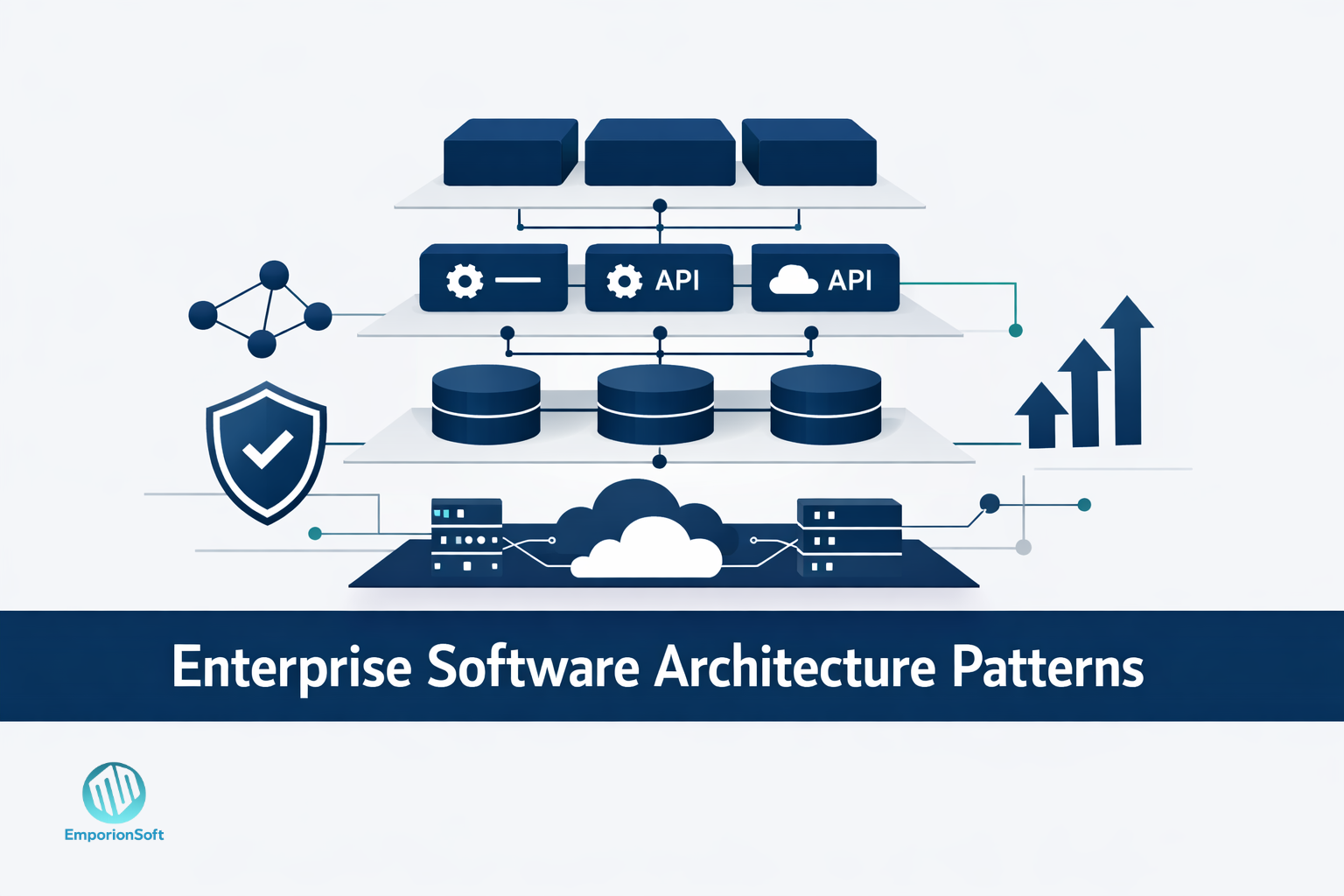
Enterprise Architecture Patterns: The Foundation of Scalable Enterprise Systems
Modern enterprises depend on software ecosystems that grow every year. New teams, products, integrations, and regions add complexity fast. Without a strong architectural foundation, that complexity turns into instability. This is where enterprise architecture patterns become critical.
Enterprise architecture patterns are proven, repeatable approaches for structuring large-scale enterprise systems. They help organisations design software that remains scalable, resilient, and adaptable over time. Instead of reacting to problems, enterprises use patterns to guide system design from the start.
At a strategic level, enterprise architecture patterns define how applications, data, integrations, and infrastructure work together. They are not tied to a single technology or platform. This makes them ideal for organisations navigating long-term growth, cloud adoption, or digital transformation.
Why Enterprises Struggle Without Architecture Patterns
Many enterprise platforms start with simple requirements. Early decisions focus on speed and delivery. Over time, those shortcuts accumulate and create tightly coupled systems that are difficult to scale or change. This is how architectural debt silently becomes a business risk.
Without a pattern-based approach, enterprises often face:
-
Fragile integrations between critical systems
-
Performance issues during peak demand
-
Duplicate data and inconsistent sources of truth
-
Rising maintenance costs and slower delivery
EmporionSoft explains this challenge clearly in Technical Debt Explained: Identify, Manage, and Eliminate, showing how early architectural choices directly impact long-term scalability and agility.
What Defines Enterprise Architecture Patterns
Enterprise architecture patterns operate at a system-wide level. They influence how applications, APIs, data stores, and infrastructure interact as a whole. This makes them essential for organisations operating across multiple teams, vendors, or geographic regions.
These patterns also create a shared architectural language. When teams align around common enterprise architecture patterns, decisions become clearer and more consistent. Governance improves without slowing down delivery.
This structured approach underpins how enterprise systems are designed and delivered through EmporionSoft’s software development services, where architecture supports scalability, security, and long-term growth.
The Business Benefits of Enterprise Architecture Patterns
Enterprise architecture patterns deliver tangible business value. They reduce risk while enabling sustainable growth. More importantly, they align technical systems with long-term business objectives.
Key enterprise architecture pattern benefits include:
-
Scalable systems that grow with demand
-
Faster adoption of new platforms and technologies
-
Reduced operational and maintenance overhead
-
Stronger governance, security, and compliance
-
Better alignment between IT strategy and business goals
Industry analysts consistently reinforce this approach. Gartner highlights enterprise architecture as a core capability for managing complexity and enabling transformation in its overview of enterprise architecture fundamentals.
Pattern-Based Enterprise Architecture in Practice
Pattern-based enterprise architecture is about intentional design. Architects select patterns that solve known problems before they appear. Integration boundaries, data ownership, and service responsibilities are defined early, reducing future rework.
This mindset becomes essential when organisations adopt cloud platforms, real-time systems, or AI-driven workloads. Architectural decisions directly affect resilience and continuity. EmporionSoft explores this connection in Building Resilient Software: Strategies for Disaster Recovery and Business Continuity.
Cloud providers promote the same principles. AWS encourages standardised architectural thinking through its Well-Architected Framework, which emphasises scalability, reliability, and security.
Laying the Groundwork for Enterprise Growth
Enterprise architecture patterns are not abstract theory. They are practical tools used daily to design systems that scale, integrate, and evolve without chaos. From enterprise platforms to global SaaS products, these patterns support reliability and long-term flexibility.
For organisations building data-driven systems, architecture plays an equally critical role. EmporionSoft’s article on Harnessing the Power of Data Lakes for Scalable Data-Driven Software Development shows how architectural foundations support analytics and growth.
Enterprise Architecture Pattern Taxonomy: How Patterns Are Classified and Applied
Once organisations understand why enterprise architecture patterns matter, the next challenge is knowing which patterns to use and when. This is where an enterprise architecture pattern taxonomy becomes essential. Without classification, patterns become confusing. With it, they become actionable.
A taxonomy groups enterprise architecture patterns based on what problem they solve and where they apply in the enterprise landscape. This structured view helps architects and decision-makers move from theory to practical system design.
Why a Pattern Taxonomy Matters in Enterprise Architecture
Large organisations rarely rely on a single architectural style. Most enterprise systems combine multiple patterns across applications, integrations, and data platforms. Without a taxonomy, these choices feel fragmented.
An enterprise architecture pattern taxonomy provides:
-
A shared decision framework across teams
-
Clear boundaries between architectural concerns
-
Faster, more confident architecture decisions
-
Better alignment with business capabilities
This structured thinking is critical when enterprises scale rapidly or operate across multiple delivery teams. It also supports long-term governance without stifling innovation.
Core Categories of Enterprise Architecture Patterns
Most enterprise architecture patterns fall into several high-level categories. Each category addresses a different layer of the enterprise system.
Enterprise Application Architecture Patterns
These patterns define how individual applications are structured internally. They focus on separation of concerns, maintainability, and scalability at the application level.
Common enterprise application architecture patterns include layered architectures and modular designs. These patterns help teams manage complexity as applications grow.
This approach aligns closely with modern software delivery practices discussed in The Software Developer’s Roadmap 2025, where architectural clarity supports long-term skill and system evolution.
Enterprise Integration Architecture Patterns
Integration patterns define how systems communicate with each other. They address challenges such as data consistency, message routing, and system decoupling.
Enterprise integration architecture patterns become critical as organisations adopt microservices, SaaS platforms, and third-party systems. Poor integration choices often lead to brittle systems and operational risk.
EmporionSoft explores scalable integration thinking in Real-Time AI in Production, where architecture directly impacts responsiveness and reliability.
Enterprise Data and Information Patterns
These patterns focus on how data is stored, shared, and governed across the enterprise. They help prevent silos and ensure consistent access to trusted information.
Enterprise architecture model patterns in this category often support analytics, reporting, and AI initiatives. Strong data architecture is a prerequisite for scalable decision-making.
A deeper look at this is covered in Harnessing the Power of Data Lakes for Scalable Data-Driven Software Development.
Reference Architectures and Blueprint Patterns
Enterprise reference architecture patterns provide high-level blueprints rather than implementation detail. They define standard structures that teams can adapt based on context.
These patterns are especially useful in large organisations where consistency across projects matters. They act as guardrails rather than constraints, enabling autonomy within a shared framework.
Many enterprises formalise these blueprints through internal architecture standards, supported by consulting and delivery partners like EmporionSoft’s enterprise consulting services.
Pattern Selection Depends on Context
There is no universal “best” enterprise architecture pattern. Pattern selection depends on factors such as business domain, regulatory constraints, scale, and team maturity.
A well-defined taxonomy helps architects ask the right questions:
-
Is this problem about application structure or system integration?
-
Does scalability or governance matter more in this context?
-
Is the organisation optimising for speed, stability, or both?
Industry leaders consistently recommend structured pattern catalogs to guide these decisions. Cloud providers like AWS promote architectural classification to reduce risk and improve consistency through their architecture best practices and reference models.
From Taxonomy to Practical Design
An enterprise architecture pattern taxonomy is not an academic exercise. It is a practical tool that helps enterprises design systems with clarity and confidence. By understanding pattern categories, organisations can combine the right patterns instead of forcing one solution everywhere.
Core Enterprise Architecture Pattern Examples Used in Real Enterprises
Understanding enterprise architecture patterns becomes far more practical when you see how they are applied in real systems. While no single pattern fits every scenario, some patterns consistently appear across successful enterprise platforms. These patterns address scalability, maintainability, and integration at scale.
In this section, we’ll explore the most widely adopted enterprise architecture pattern examples and explain when each one works best.
Layered Architecture Pattern in Enterprise Systems
The layered architecture pattern is one of the most common enterprise architecture patterns. It organises applications into distinct layers, each with a clear responsibility. Typical layers include presentation, business logic, and data access.
This separation improves maintainability and makes systems easier to understand. Teams can modify one layer without impacting others, as long as interfaces remain stable. For enterprises maintaining large, long-lived applications, this predictability is a major advantage.
However, layered architectures can become rigid if not managed carefully. Too many dependencies between layers may slow down change. This is why layered architecture is often combined with other enterprise architecture model patterns rather than used in isolation.
This pattern is particularly effective for regulated industries or systems with well-defined workflows, where stability matters more than rapid change.
Microservices Architecture Pattern in Enterprise Environments
The microservices architecture pattern has become a cornerstone of modern enterprise systems. Instead of building a single large application, functionality is split into small, independent services. Each service owns its data and lifecycle.
For large organisations, this pattern enables teams to work independently and deploy changes without coordinating massive releases. It also supports scalability, as individual services can scale based on demand.
That said, microservices introduce operational complexity. Service discovery, monitoring, and data consistency become architectural concerns. Without strong governance, microservices can create chaos rather than agility.
EmporionSoft explores the practical realities of operating complex distributed systems in Real-Time AI in Production, where architectural choices directly affect latency and reliability.
Microservices work best for enterprises with mature DevOps practices and clear domain boundaries.
Service-Oriented Architecture Patterns (SOA)
Service-oriented architecture patterns predate microservices but remain highly relevant in enterprise environments. SOA focuses on exposing business capabilities as reusable services, often through centralised integration layers.
In many enterprises, SOA acts as a bridge between legacy systems and modern platforms. It enables reuse and integration without requiring full system replacement. This makes SOA especially valuable during gradual digital transformation.
SOA patterns emphasise governance and standardisation. While this can slow down change, it also reduces risk in highly regulated environments. For organisations balancing innovation with stability, SOA remains a practical option.
The relationship between architecture, governance, and transformation is also discussed in Adaptive Software Development, which highlights how systems must evolve without breaking existing operations.
Choosing the Right Pattern for Enterprise Context
Each of these enterprise architecture pattern examples solves a different problem. Layered architectures prioritise clarity and control. Microservices prioritise scalability and autonomy. SOA prioritises reuse and integration.
The key is not choosing one pattern blindly, but aligning patterns with business needs, team maturity, and operational capability. Many enterprises combine patterns across different system areas.
Cloud providers reinforce this balanced approach. Google Cloud’s architectural guidance promotes selecting patterns based on workload characteristics rather than trends, as outlined in its architecture design principles.
Patterns as Building Blocks, Not Prescriptions
Enterprise architecture patterns should be treated as building blocks. They provide structure, not strict rules. Successful enterprises adapt patterns to their context rather than copying them wholesale.
Understanding these core patterns creates a strong foundation. It also prepares organisations to explore more advanced patterns used in large-scale and distributed systems.
Advanced and Distributed Enterprise Architecture Patterns at Scale
As enterprises grow beyond single platforms and teams, traditional architectures begin to show limits. Systems must handle real-time data, regional autonomy, and constant change. This is where advanced and distributed enterprise architecture patterns become essential.
These patterns are designed for scale, resilience, and organisational complexity. They are commonly used by global enterprises, high-growth platforms, and organisations undergoing large-scale digital transformation.
Event-Driven Architecture in Enterprise Systems
Event-driven architecture is a powerful pattern for enterprises that require real-time responsiveness. Instead of tightly coupling systems through direct calls, applications communicate through events.
When something meaningful happens in the system, an event is published. Other services react to it asynchronously. This approach reduces dependencies and improves scalability.
Event-driven architecture works particularly well for:
-
Real-time analytics and monitoring
-
Financial transactions and notifications
-
IoT and streaming data platforms
-
AI and automation workflows
However, this pattern requires mature observability and governance. Without proper monitoring, debugging event flows can become challenging.
EmporionSoft explores how real-time architectures support modern intelligent systems in Real-Time AI in Production, where event-driven designs enable low-latency decision-making.
Industry leaders also promote this approach. AWS highlights event-driven patterns as a core design strategy in its enterprise architecture guidance.
Federated Architecture Pattern for Large Organisations
The federated architecture pattern is commonly used in large enterprises with multiple business units or regions. Instead of enforcing a single central architecture, federated models allow local autonomy within shared standards.
Each domain or business unit owns its systems while aligning with enterprise-wide principles. This balance enables speed without sacrificing governance.
Federated architecture is especially effective when:
-
Organisations operate across countries or regions
-
Different units have unique regulatory requirements
-
Multiple product lines evolve independently
The challenge lies in coordination. Without strong architectural principles, federation can drift into fragmentation. This is why federated models rely heavily on shared standards and reference architectures.
This balance between autonomy and alignment is also discussed in Adaptive Software Development, which highlights how systems evolve in complex environments.
Distributed Architecture Patterns in Enterprise Environments
Distributed architecture patterns address the reality that modern enterprise systems rarely live in one place. Applications, data, and users are spread across cloud platforms, data centres, and regions.
These patterns focus on:
-
Fault tolerance and high availability
-
Data replication and consistency
-
Latency optimisation across regions
Distributed architectures support global scale but introduce complexity. Decisions around data ownership, consistency models, and failure handling become architectural priorities.
EmporionSoft covers the importance of designing for failure in Building Resilient Software: Strategies for Disaster Recovery and Business Continuity, where distributed patterns play a central role.
Cloud providers reinforce this thinking. Google Cloud emphasises designing distributed systems with failure as a first-class concern in its architecture design principles.
When Advanced Patterns Make Sense
Advanced enterprise architecture patterns are not a default choice. They introduce operational and governance overhead. Enterprises adopt them when scale, speed, and resilience outweigh simplicity.
Key signals that advanced patterns are needed include:
-
Rapid organisational growth
-
High transaction volumes or real-time processing
-
Multiple autonomous teams or regions
-
Strict availability and resilience requirements
When applied intentionally, these patterns unlock agility without chaos.
Preparing for the Next Architectural Decision
Advanced and distributed enterprise architecture patterns enable enterprises to operate at scale without collapsing under complexity. They also demand disciplined governance and skilled teams.
Understanding these patterns prepares organisations to make informed architectural trade-offs rather than reactive fixes.
Enterprise Architecture Patterns vs Architecture Frameworks: Clearing the Confusion
As organisations mature architecturally, a common question emerges: how do enterprise architecture patterns differ from architecture frameworks? The two are often used interchangeably, yet they serve very different purposes. Understanding this distinction is critical for effective enterprise design.
Enterprise architecture patterns focus on how systems are structured. Architecture frameworks focus on how architecture is governed and documented. When used together correctly, they complement each other. When confused, they create unnecessary complexity.
What Architecture Frameworks Are Designed to Do
Architecture frameworks such as TOGAF, Zachman, and SAFe provide structured ways to describe and manage enterprise architecture. They define processes, viewpoints, and governance models rather than technical solutions.
Frameworks help organisations answer questions like:
-
Who makes architectural decisions?
-
How are architectures documented and reviewed?
-
How does architecture align with business strategy?
They are particularly useful in large enterprises where consistency, compliance, and traceability matter.
For organisations navigating enterprise-scale transformation, this governance mindset aligns closely with EmporionSoft’s approach to enterprise consulting and advisory services, where structure supports long-term delivery outcomes.
What Enterprise Architecture Patterns Actually Provide
Enterprise architecture patterns, on the other hand, are practical design tools. They address specific structural problems such as integration complexity, scalability, or system resilience.
Patterns answer questions like:
-
Should this system be event-driven or request-based?
-
How should services be decomposed?
-
Where should data ownership live?
This makes patterns immediately actionable. Architects and engineers apply them directly to system design without waiting for governance cycles.
This practical focus is reflected in EmporionSoft’s insights on building scalable and adaptive software systems, where architecture decisions directly affect speed and reliability.
Why Patterns and Frameworks Are Not Competing
One of the most common enterprise mistakes is treating patterns and frameworks as alternatives. In reality, they operate at different levels.
Frameworks provide the structure for decision-making. Patterns provide the content of those decisions. A framework might say when architecture reviews occur, while patterns define what solutions are acceptable.
For example, TOGAF may guide how architecture evolves over time. Enterprise architecture patterns guide whether microservices, layered designs, or event-driven systems are appropriate.
Industry analysts consistently reinforce this distinction. Gartner highlights that effective enterprise architecture combines governance discipline with practical design guidance in its overview of enterprise architecture principles.
Pattern-Based Enterprise Architecture Within Frameworks
Mature organisations embed enterprise architecture patterns inside their chosen frameworks. Patterns become part of reference architectures, standards, and approved design options.
This approach delivers several advantages:
-
Faster architecture decisions
-
Reduced design inconsistency
-
Lower dependency on individual architects
-
Better alignment across delivery teams
Cloud providers also support this model. AWS promotes reference architectures and reusable patterns within governance structures, reinforcing the idea that patterns and frameworks work best together.
Choosing the Right Balance for Your Organisation
Not every organisation needs a heavy framework. Not every system needs advanced patterns. The right balance depends on scale, regulatory pressure, and delivery maturity.
Smaller teams may rely more on patterns with lightweight governance. Large enterprises often require both strong frameworks and disciplined pattern catalogs.
EmporionSoft helps organisations find this balance by aligning architectural structure with real delivery needs, rather than forcing theory into practice.
Pattern Governance and Decision Models in Enterprise Architecture
As enterprises adopt more architecture patterns, the challenge shifts from selection to control. Without governance, patterns drift. Teams implement them inconsistently. Over time, architectural entropy returns. This is why pattern governance is a critical pillar of enterprise architecture maturity.
Pattern governance ensures that enterprise architecture patterns are applied intentionally, reviewed regularly, and evolved as business needs change. It protects long-term system health without blocking innovation.
Why Pattern Governance Matters at Enterprise Scale
In large organisations, architecture decisions happen constantly. New projects launch. Legacy systems evolve. Teams make local trade-offs. Without a shared governance model, those decisions fragment the architecture.
Effective pattern governance helps enterprises:
-
Maintain consistency across teams and vendors
-
Reduce architectural risk and rework
-
Improve system interoperability
-
Align technical design with business priorities
This governance-first mindset aligns closely with EmporionSoft’s approach to enterprise software consulting and delivery, where architectural clarity supports sustainable growth across complex environments.
The Enterprise Architecture Pattern Decision Guide
Mature organisations use a structured EA pattern decision guide to help teams choose the right pattern for each scenario. This guide does not dictate solutions. Instead, it frames decisions around context and constraints.
Typical decision criteria include:
-
Business criticality and availability requirements
-
Expected scale and growth rate
-
Regulatory and security constraints
-
Team skills and operational maturity
By asking the right questions upfront, enterprises avoid overengineering while still planning for scale.
This principle of context-driven decision-making is also explored in Adaptive Software Development, which highlights how architecture must evolve alongside business needs.
Architecture Review Boards and Pattern Enforcement
Many enterprises formalise governance through architecture review boards. These groups are responsible for approving patterns, maintaining reference architectures, and resolving design conflicts.
When done well, review boards act as enablers rather than gatekeepers. They provide guidance early, not roadblocks late. They also ensure lessons learned in one project benefit the entire organisation.
EmporionSoft frequently supports organisations in setting up lightweight governance models that balance speed with architectural discipline, particularly during transformation initiatives.
Avoiding Anti-Patterns and Governance Pitfalls
Governance itself can become a problem if handled poorly. Overly rigid controls slow delivery. Excessive documentation discourages innovation. The goal is guidance, not bureaucracy.
Common enterprise architecture anti-patterns include:
-
Mandating patterns without context
-
Allowing unchecked pattern sprawl
-
Treating governance as a one-time exercise
-
Ignoring operational feedback from delivery teams
Enterprises that succeed revisit their pattern catalogs regularly. They retire outdated patterns and refine decision models as technology and business evolve.
Industry research supports this adaptive approach. Leading architecture practices emphasise continuous learning and feedback as core governance principles.
Patterns as Strategic Assets, Not Static Rules
Enterprise architecture patterns should be treated as strategic assets. They capture organisational knowledge and encode hard-earned lessons. When governed well, patterns reduce dependency on individuals and improve long-term delivery confidence.
This is especially important for enterprises operating globally or across multiple delivery partners. A shared pattern language keeps systems coherent even as teams change.
EmporionSoft’s case studies demonstrate how disciplined architecture governance enables enterprises to scale delivery without sacrificing quality or resilience.
Preparing for the Final Architectural Decision
Pattern governance is the bridge between theory and execution. It ensures enterprise architecture patterns remain relevant, usable, and aligned with business goals.
Choosing the Right Enterprise Architecture Patterns for Long-Term Success
Enterprise systems rarely fail because of technology alone. They fail because architectural decisions do not scale with business reality. Throughout this guide, we’ve explored how enterprise architecture patterns provide structure, clarity, and resilience in complex environments.
From layered and microservices designs to event-driven and federated models, each pattern solves a specific class of problems. The real value comes from knowing when to use each pattern, how to combine them, and how to govern them over time.
Turning Patterns into Practical Strategy
Enterprise architecture patterns are not checklists. They are strategic tools. When applied correctly, they help organisations:
-
Scale systems without constant redesign
-
Integrate new platforms without disrupting operations
-
Balance innovation with governance
-
Reduce long-term operational and architectural risk
The most successful enterprises do not chase trends. They adopt patterns deliberately, guided by business priorities, regulatory needs, and delivery maturity. This is why pattern-based enterprise architecture consistently outperforms ad-hoc design approaches.
Architecture as a Business Enabler
Architecture decisions shape how fast organisations can respond to change. They influence time-to-market, reliability, and customer experience. As digital transformation accelerates, architecture becomes a board-level concern rather than a purely technical one.
Enterprises investing in cloud platforms, AI systems, and real-time data pipelines increasingly rely on enterprise architecture patterns to maintain control without slowing progress. This balance is essential for sustainable growth.
EmporionSoft works with organisations across industries to design enterprise architectures that align technology with long-term business outcomes. Through structured consulting, delivery, and advisory services, architecture becomes an enabler rather than a constraint.
You can explore how this approach translates into real-world impact through EmporionSoft’s Case Studies, which showcase scalable enterprise systems delivered across global markets.
When to Seek Expert Architecture Guidance
Not every organisation needs a full architectural overhaul. But most benefit from expert guidance when:
-
Systems begin to slow innovation
-
Integrations become fragile or expensive
-
Cloud or AI adoption introduces complexity
-
Multiple teams struggle with inconsistent design decisions
At these moments, a structured review of enterprise architecture patterns can prevent costly missteps and unlock new efficiency.
EmporionSoft supports enterprises at every stage of this journey, from architectural assessment to implementation and governance. Whether you are modernising legacy systems or designing new platforms, the right architectural foundation makes the difference.
Start Building with Confidence
Enterprise architecture patterns provide the clarity enterprises need to grow with confidence. When paired with the right governance and expertise, they turn complexity into capability.
If you’re ready to strengthen your enterprise architecture, explore EmporionSoft’s Services to see how structured system design supports scalable delivery. For tailored guidance, you can also request a strategic discussion through the Consultation page or reach out directly via the Contact Us page.
Strong architecture is not about perfection. It’s about making the right decisions early—and revisiting them intentionally as your organisation evolves.