
Why ERP Software for Schools in Pakistan Is Becoming a 2026 Priority
Schools in Pakistan are no longer dealing with administration as a back office problem. For many private schools, college groups, and government education departments, administration now affects fee recovery, parent trust, reporting accuracy, teacher accountability, and the quality of daily decision making.
This is why ERP software for schools Pakistan has become a serious 2026 buying priority. The need is not only to digitise records. The real need is to bring admissions, attendance, fees, exams, staff activity, communication, and reporting into one connected system.
For years, many schools have used a mix of registers, spreadsheets, WhatsApp groups, disconnected fee tools, and manual result sheets. These systems may work when a school is small, but they become harder to control as student numbers grow. A principal may know the school is busy, but still lack a clear view of unpaid fees, daily attendance, teacher workload, parent complaints, or exam performance across classes.
That gap becomes even larger in multi-campus schools and education departments. When each campus maintains its own records, leadership has to wait for reports, verify figures manually, and resolve conflicts between different versions of the same data. A school management system Pakistan 2026 should reduce that dependency on scattered files and delayed updates.
The same pressure is visible in public education. Government offices need more reliable digital records, faster reporting, and better visibility across schools. Manual reporting can delay decisions around enrolment, staff deployment, attendance monitoring, and resource planning. A well-planned education ERP Pakistan government system can help departments move from reactive administration to structured oversight.
This is also where paperless school system Pakistan becomes more than a convenience term. Paperless does not mean removing every printed document overnight. It means reducing the routine dependence on physical files where digital workflows are safer, faster, and easier to audit. Student profiles, fee histories, attendance logs, result records, staff information, and parent notifications all become more useful when they are stored in one controlled platform.
International education technology research also supports this shift toward stronger digital systems. The UNESCO Global Education Monitoring Report on technology in education highlights that technology only adds value when it is used with clear purpose, proper governance, and real institutional need. For Pakistani schools, that means ERP should not be treated as a trendy software purchase. It should be evaluated as operational infrastructure.
For SMEs, school owners, and education leaders, the main question is changing. It is no longer, “Should we use school software?” The better question is, “What kind of ERP system can support our actual processes, local compliance needs, reporting structure, and future growth?”
This is where local delivery experience matters. A vendor that understands Pakistani education workflows, government style reporting, fee models, language needs, and multi-campus operations can design a system that fits the institution rather than forcing the institution to fit the software. EmporionSoft’s broader software development services position this type of work as a practical engineering problem, not just a dashboard design exercise.
In 2026, school ERP adoption in Pakistan is being driven by a simple reality. Education leaders need cleaner data, faster administration, better accountability, and systems that can scale without creating new operational confusion.
The Operational Problems a School ERP Should Actually Solve
A school ERP should not be judged by the number of modules shown in a demo. It should be judged by the problems it removes from daily operations. For Pakistani schools, the strongest ERP systems are the ones that reduce manual work, improve visibility, and make routine administration easier to control.
The first problem is fragmented student records. Many schools store admissions data in one file, fee history in another, attendance in registers, exam marks in spreadsheets, and parent contact details in staff phones. This creates duplication and weak accountability. When records are scattered, even simple questions become slow to answer.
A proper student information system Pakistan should give leadership one accurate profile for each student. That profile should connect admissions, class placement, attendance, fees, results, disciplinary notes, certificates, and parent communication. Without this foundation, every other module becomes less reliable.
Fee management is another major operational pressure. In many schools, unpaid balances are tracked manually, receipts are checked by office staff, and fee reports are prepared after delays. This can create confusion between parents, accounts teams, and school leadership. A strong ERP should make fee status visible in real time, support instalment plans, generate receipts, track concessions, and reduce dependency on manual reconciliation.
Attendance tracking is equally important. Paper registers may be familiar, but they make reporting slow and difficult to verify. Digital attendance gives schools faster visibility into absences, late arrivals, class trends, and teacher reporting discipline. When connected with parent notifications, it also improves communication without requiring staff to call every family manually.
Result management is another area where schools often lose time. Teachers enter marks, coordinators compile sheets, administrators verify totals, and leadership waits for final reports. A school ERP should reduce this chain of manual handling. It should support exam structures, grading rules, subject wise marks, report cards, performance trends, and class level comparisons.
The problem is not only speed. It is accuracy. Manual result compilation increases the chance of calculation errors, missing marks, and inconsistent formats. For schools that want parent trust and better academic monitoring, clean result workflows are essential.
Parent communication also needs structure. WhatsApp groups are useful, but they are not a reliable system of record. Messages get missed, staff use personal numbers, and important updates are buried under casual conversation. A school ERP should support controlled parent notifications for attendance, fees, homework, announcements, results, and meetings.
This is where a paperless school system Pakistan creates real value. The aim is not to remove every human process. The aim is to remove repetitive manual work that slows the school down. Digital records should help administrators spend less time searching, copying, verifying, and rechecking the same information.
Poor systems also create hidden technical debt. Over time, schools build workarounds around spreadsheets, outdated software, shared passwords, and informal reporting habits. EmporionSoft’s guide on technical debt and how to manage it explains how these small operational shortcuts can become long term risks when they are not addressed early.
A useful ERP should bring structure to the school’s actual workflows. It should help office staff process fees faster, teachers update records more consistently, principals read reports more clearly, and parents receive timely information. International guidance from the World Bank on digital technologies in education also shows that technology works best when it supports real education systems rather than adding isolated tools.
For Pakistani schools, ERP adoption should begin with one practical question: which daily problems are wasting the most time, creating the most errors, or limiting the school’s ability to make better decisions?
Core Features to Look for in a School Management System Pakistan 2026
A school ERP should be selected around workflows, not feature names. Many platforms show similar modules on paper, but the real difference appears when teachers, accountants, administrators, parents, and leadership start using the system every day.
The first core feature is a reliable student information system. Every student should have one complete digital profile that connects admission details, guardian records, class history, attendance, fees, exam performance, documents, and communication history. This prevents duplicate records and gives staff a single reference point for routine decisions.
Fee management is another essential module for schools in Pakistan. A strong fee management system school Pakistan should support monthly fees, annual charges, discounts, concessions, late fees, instalments, arrears, receipts, refunds, and financial reporting. It should also allow school leadership to see collection status without waiting for manual reports from the accounts office.
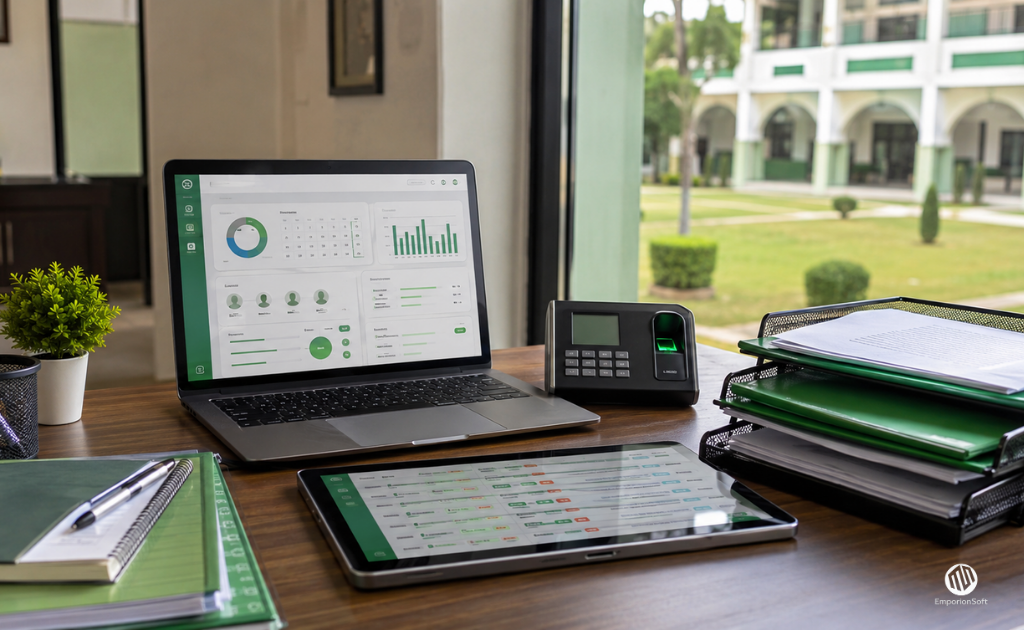
Digital attendance is equally important. A digital attendance system school Pakistan should let teachers mark attendance quickly while giving administrators live visibility into absences, late arrivals, and class level patterns. For larger schools, biometric integration can improve verification, especially for staff attendance and controlled entry points. The system should also support parent notifications when students are absent or late.
Result management should be more than a marks entry screen. Schools need flexible exam structures, subject groups, grading rules, term based reports, class averages, position calculations, remarks, and printable report cards. Good result workflows reduce calculation errors and help leadership identify weak subjects, struggling classes, or performance changes over time.
A teacher portal is another practical requirement. Teachers should be able to manage attendance, homework, marks, lesson updates, class notices, and student observations from one controlled account. This reduces dependency on office staff and helps schools distribute responsibility across the academic team.
Parent communication should also be built into the ERP. Parent portals and notifications can cover attendance alerts, fee reminders, exam results, announcements, homework, meeting updates, and transport notices. This is more reliable than depending only on WhatsApp groups or informal calls, especially when communication needs to be recorded.
For multi-campus schools, central control matters. The ERP should allow leadership to compare campuses, standardise reports, manage permissions, and track performance across branches. A campus should have enough autonomy for daily work, but the owner or department head should still have central visibility.
Reporting is where many weak systems fail. A school management system Pakistan 2026 should provide useful dashboards for fees, attendance, admissions, exams, staff activity, and student performance. Reports should not require technical knowledge to understand. They should help principals and department heads act faster.
The technical foundation also matters. Systems that handle student records, fee data, and academic history need proper database design, access control, backups, and integration readiness. EmporionSoft’s guide on SQL vs NoSQL database decisions explains why database choices should match the structure, scale, and reporting needs of the application.
If the ERP needs to connect with mobile apps, biometric devices, SMS gateways, payment systems, or government dashboards, API design becomes important. The principles covered in scalable API design for SaaS platforms are especially relevant for education systems that may expand across campuses or departments.
The best ERP features are not the ones that look impressive in a sales demo. They are the ones that match the school’s actual operating model, reduce repeated work, protect records, and give decision makers a clearer view of the institution.
Government, Compliance, and Data Risks in Education ERP Pakistan
Education ERP Pakistan government projects carry a different level of responsibility from ordinary school software. A private school may need better attendance, fees, and parent communication. A government department also needs policy level reporting, secure digital records, audit trails, access control, and long term accountability across many institutions.
The first risk is student data protection. A school ERP stores sensitive information, including student names, guardian details, attendance history, fee records, academic results, disciplinary notes, documents, and sometimes biometric data. If this information is poorly protected, the risk is not only technical. It can affect parent trust, institutional credibility, and public sector confidence.
Access control must be designed carefully. A class teacher should not see the same information as a principal, accounts officer, district official, or system administrator. Role based permissions help ensure that users only access the records needed for their work. This is especially important in multi-campus schools and department level systems where many users operate inside the same platform.
Audit trails are equally important. A strong education ERP should record who created, updated, approved, or deleted important records. Fee changes, result edits, attendance corrections, student transfers, and staff updates should not disappear without trace. Audit logs give leadership a reliable way to investigate errors and reduce misuse.
Government compliance also depends on reporting accuracy. Education departments need clean data for enrolment, attendance, staffing, infrastructure, performance, and resource planning. If school level data is incomplete or inconsistent, department level decisions become weaker. This is why digital records must follow a standard structure across schools, campuses, and administrative layers.
The AJ&K education software context is important here because government education systems require more than attractive dashboards. They require workflows that match real administrative practice. EmporionSoft’s experience with education ERP work, referenced through its case studies section, supports the idea that public sector software needs domain understanding, not only development capacity.
Hosting and backups also need serious attention. Schools should know where their data is stored, how often it is backed up, who can access the server, and what happens if the system goes offline. A weak backup process can turn a small technical issue into a major administrative disruption.
Security should also be part of the development process from the beginning. Password policies, secure login, permission testing, database protection, server monitoring, and update management should not be added after launch as emergency fixes. EmporionSoft’s guide on DevSecOps for small teams explains why security needs to sit inside the delivery process rather than outside it.
Data privacy frameworks are also relevant for education buyers. Even when local requirements are still developing, schools and departments should follow clear principles around consent, access, retention, deletion, and responsible use of student information. The guide on data privacy frameworks is useful for understanding how structured privacy thinking can reduce long term risk.
International education guidance also points to the same principle. The World Bank’s work on digital technologies in education shows that education technology needs governance, infrastructure, and implementation discipline to create value.
For Pakistani schools and government departments, ERP risk is not limited to choosing the wrong software. The larger risk is choosing a system without proper controls, weak data governance, limited auditability, and no clear ownership model for the records that matter most.
How to Evaluate School Software Pakistan Price and Total Cost
School software Pakistan price should not be judged only by the monthly licence fee or the first quotation a vendor sends. A low starting price can become expensive if the system needs heavy customisation, weak support, repeated manual work, or replacement after one academic year.
For schools in Pakistan, the better approach is to evaluate total cost of ownership. This means looking at the full cost of buying, implementing, running, supporting, and improving the ERP over time. ERP software for schools Pakistan is not only a software purchase. It becomes part of daily administration, accounts, academics, parent communication, and reporting.
The first cost is setup and configuration. A school ERP needs student classes, fee structures, subjects, exam terms, staff roles, user permissions, branches, reports, and communication rules. If a school has multiple campuses or complex fee categories, setup will require more planning than a simple single campus system.
Customisation is another major cost factor. Many schools need local workflows, such as admission stages, scholarship rules, arrears handling, sibling discounts, transport charges, staff attendance, or custom report cards. A standard platform may cover basic needs, but custom school management software Pakistan becomes more relevant when the institution has processes that cannot be handled by fixed templates.
Data migration should also be included in the budget. Existing student records, fee histories, exam marks, parent contacts, staff details, and attendance records may need to move from spreadsheets or older systems into the new ERP. Poor migration creates confusion after launch, especially if fee balances or student records do not match office files.
Training is often underestimated. Teachers, accountants, front desk staff, coordinators, principals, and administrators all use the system differently. Even a strong ERP can fail if users are not trained properly. Schools should ask whether training is included, how many sessions are provided, and whether support is available after staff begin using the system in real conditions.
Hosting and maintenance also affect long term cost. Cloud hosting, database backups, security updates, uptime monitoring, bug fixes, and performance improvements all need ownership. EmporionSoft’s guide on cloud cost optimization explains why cloud expenses should be planned carefully instead of treated as a hidden technical line item.
Integrations can also change the final price. A fee management system school Pakistan may need SMS alerts, WhatsApp notifications, online payment support, biometric integration, mobile apps, or accounting exports. These integrations are useful, but they add development, testing, support, and sometimes third party service charges.
Support quality should be part of the pricing decision. A cheap system with slow support can cost more during admission season, exam weeks, fee collection periods, or report card preparation. Schools should ask about response time, support channels, maintenance scope, upgrade policy, and whether the vendor understands local education workflows.
Return on investment should be measured through practical outcomes. These may include faster fee recovery, fewer manual errors, reduced paper use, quicker report generation, better parent communication, cleaner student records, and improved leadership visibility. EmporionSoft’s article on technology ROI metrics is useful for thinking beyond purchase price and measuring value through operational impact.
The TheCodeV build vs buy framework is also relevant when comparing ready made platforms with custom ERP development. A school with simple needs may benefit from a standard system, while a large network or education department may need a more tailored platform.
The right pricing question is not, “What is the cheapest school ERP?” It is, “Which system gives the institution reliable operations, controlled cost, and enough flexibility to support future growth?”
Custom School Management Software Pakistan vs Off the Shelf Platforms
The decision between custom school management software Pakistan and an off the shelf platform should not begin with technology. It should begin with operational complexity. A small school with standard fee structures, simple attendance, and limited reporting needs may work well with a ready made system. A large school network, college group, or education department may need a more tailored ERP because the workflows are harder to standardise.
Off the shelf platforms usually offer faster deployment. They often include basic modules for student records, fees, attendance, exams, staff management, and parent communication. For schools that want to move quickly from registers and spreadsheets into a digital system, this can be a practical first step.
The limitation appears when the institution has processes that do not fit the product. A school may have unusual fee rules, branch level reporting needs, government style data formats, bilingual communication, complex result structures, or specific approval workflows. When the software cannot adapt, staff begin creating side processes in spreadsheets and WhatsApp groups. This weakens the value of the ERP.
Custom ERP development works differently. It starts with the school’s actual operating model, then designs the system around those workflows. This can be useful for education ERP Pakistan government projects, KPK Punjab school ERP system requirements, and multi-campus school groups that need central visibility with local control at each campus.
The advantage of custom software is fit. The system can be shaped around admissions, fee policies, attendance rules, exam formats, department reporting, staff permissions, parent notifications, biometric integration, and future modules. It can also integrate with local payment providers, SMS gateways, dashboards, or government systems when needed.
The tradeoff is time and planning. Custom ERP needs discovery, documentation, design, development, testing, training, and long term support. It should not be treated as a quick purchase. It is closer to building institutional infrastructure. EmporionSoft’s article on enterprise architecture patterns is useful for understanding how larger systems need structure before they scale.
Off the shelf platforms can also be a good choice when the school wants predictable pricing and standard features. The risk is vendor lock in if the platform does not allow enough flexibility. Some products make it difficult to customise reports, export data, add integrations, or adjust workflows later.
Custom systems offer more control over data ownership, permissions, integrations, and future changes. This matters when the ERP becomes central to fees, academic records, attendance, compliance, and reporting. EmporionSoft’s guide on custom CRM vs SaaS platforms explains a similar decision pattern that also applies to school ERP selection.
The TheCodeV build vs buy framework is a useful way to frame this choice. Schools should buy when the process is common and the available software fits well. They should build when the process is strategic, complex, locally specific, or difficult to manage through generic tools.
For Pakistani schools, the best answer is not always custom and not always ready made. The right choice depends on size, budget, reporting needs, compliance pressure, number of campuses, internal capacity, and long term growth plans.
A school ERP should support how the institution actually works. If the platform forces staff to keep parallel records, the buying decision needs to be reconsidered before the system becomes another operational burden.
ERP Implementation Roadmap for Schools, Campuses, and Departments
A school ERP implementation should not begin with software installation. It should begin with process clarity. Schools in Pakistan often move towards digital systems because administration feels slow, but the real work is understanding why it feels slow and which workflows need to change first.
The first stage is discovery. The school, campus group, or education department should map how admissions, fees, attendance, exams, staff records, parent communication, and reports currently work. This includes who enters data, who approves changes, who reads reports, and where delays usually happen.
This stage is important because ERP software for schools Pakistan must reflect real operations. If the vendor only copies old manual processes into a digital interface, the school may gain screens without gaining efficiency.
The second stage is workflow mapping. Each major process should be written clearly before development or configuration begins. For example, fee management should define billing cycles, concessions, arrears, late fees, receipts, refunds, and reporting access. Attendance should define teacher responsibilities, absence marking, biometric integration if needed, and parent notifications.
The third stage is data preparation. Schools usually have student records in spreadsheets, registers, old software, or mixed formats. Before migration, the data should be cleaned, standardised, and checked for duplicates. Student names, guardian contacts, class allocations, fee balances, admission numbers, and academic records need careful review.
A student information system Pakistan becomes reliable only when the starting data is reliable. Poor migration can create disputes after launch, especially around unpaid fees, class placement, or result history.
The fourth stage is configuration and development. This includes user roles, permissions, campus settings, fee structures, exam formats, report templates, notification rules, dashboards, and integrations. A single campus school may need a lighter setup. A multi-campus network or department level ERP will need stricter hierarchy, central controls, and branch level access.
The fifth stage is pilot testing. Schools should not launch every module to every user at once. A safer approach is to test the system with one campus, one class group, or one department function first. This helps identify confusing screens, missing reports, data issues, and training gaps before full rollout.
EmporionSoft’s beta testing guide is useful here because ERP testing should involve real users, not only developers. Teachers, accountants, clerks, coordinators, and principals will notice different issues because they use the system from different angles.
The sixth stage is training. A paperless school system Pakistan cannot succeed if users feel forced into a system they do not understand. Training should be role based. Teachers need attendance, marks, homework, and class communication training. Accounts teams need fee workflows. Leadership needs dashboards and reports. Administrators need permissions, records, and support procedures.
The seventh stage is phased rollout. Schools can begin with core records, fees, and attendance, then add result management, parent portals, transport, staff attendance, and advanced reporting. This reduces operational shock and allows teams to adapt gradually.
The eighth stage is post launch support. During the first academic cycle, the ERP should be monitored closely. Admission season, fee deadlines, exam periods, and report card generation will reveal practical issues that do not always appear during testing.
Education systems also need governance after launch. The World Bank’s education technology resources repeatedly emphasise that digital education initiatives need planning, capacity, and system level ownership. For schools, this means assigning responsibility for data quality, user access, backups, support requests, and reporting standards.
Implementation is not a one time event. It is the process of turning school operations into a controlled digital system that staff can trust and leadership can use for better decisions.
Choosing a Proven School ERP Partner for Long Term Digital Education Growth
Choosing ERP software for schools Pakistan is not only a technology decision. It is an institutional decision that affects administration, finance, academic records, parent communication, compliance, and leadership visibility for years.
The right ERP partner should understand that schools do not operate like ordinary businesses. A school handles student records, fee cycles, attendance, examinations, staff coordination, parent expectations, and official reporting at the same time. If the software partner does not understand these workflows, the final system may look modern but fail under daily pressure.
For school owners and principals, the first evaluation point should be operational fit. The ERP should match how the institution manages admissions, fees, classes, exams, attendance, communication, and reporting. A system that requires staff to maintain parallel spreadsheets is not solving the problem. It is simply adding another layer of work.
For education departments, the decision is even more strategic. Education ERP Pakistan government systems need strong data governance, role based access, audit trails, reporting standards, secure hosting, and long term support. A department level platform must work across many schools, user roles, locations, and reporting requirements. That requires more than software installation. It requires serious discovery, process mapping, and implementation discipline.
Evidence of delivery matters. Many vendors can describe school ERP features, but fewer can show relevant experience in real education environments. EmporionSoft’s AJ&K education software experience gives it a stronger position in this category because government education ERP work involves practical constraints that generic platforms often miss. Buyers can explore related delivery context through EmporionSoft case studies.
The vendor should also be able to discuss cost clearly. School software Pakistan price should be connected to scope, number of users, campuses, modules, integrations, hosting, training, migration, and support. If pricing is vague, schools may face unexpected costs after the project begins. A reliable partner should help the institution understand what is essential now, what can be phased later, and what should not be built until there is a clear need.
Scalability is another key factor. A school may begin with admissions, fee management, attendance tracking, and result management. Later, it may need biometric integration, parent apps, transport, HR, finance, analytics, or government dashboard integrations. The ERP should be planned so that future expansion does not require rebuilding the system from the beginning.
The same principle applies to digital governance. The UNESCO Global Education Monitoring Report on technology in education reinforces that education technology should be guided by purpose, evidence, and responsible use. For Pakistani schools, this means ERP should support better administration and stronger decision making, not simply add more screens.
A proven school ERP partner should bring three qualities together: education domain understanding, software engineering depth, and implementation support. Schools need a team that can listen carefully, map real workflows, protect records, train users, and remain accountable after launch.
For institutions planning a paperless school system Pakistan in 2026, the safest path is to start with a structured discussion. Define the current problems, identify the highest value modules, review reporting needs, and decide whether a ready made platform, custom school management software Pakistan, or a phased hybrid approach makes the most sense.
Schools, campuses, and education departments that want a practical ERP roadmap can begin with a consultative review through EmporionSoft consultation. The goal should not be to buy software quickly. It should be to build a system that supports cleaner records, stronger accountability, and better education operations over the long term.