
Real Estate Software Development Pakistan: How Property Portals Are Built
Real estate software development Pakistan buyers should expect more than a listing website. A serious property platform needs structured listings, search filters, map integration, agent workflows, buyer enquiries, CRM logic, admin moderation, and long term maintenance. Cost depends on whether you are building a simple portal, a mobile app, or a full PropTech operating system.
Why real estate software development in Pakistan is now a serious PropTech decision
Pakistan’s property market has always relied heavily on relationships, location knowledge, agent networks, and buyer confidence. Software does not replace those fundamentals. It organises them.
For agents, developers, and PropTech founders, the shift is clear. A basic brochure website is no longer enough when buyers expect searchable listings, location context, verified details, quick enquiries, saved preferences, and mobile friendly browsing. Property businesses now need systems that support how people actually search, compare, shortlist, and enquire.
That is why real estate software development Pakistan is becoming a commercial decision rather than a simple website project. The buyer is not only asking for design. They are asking how a property business can operate through a digital platform.
Large local portals have already shaped user expectations. Zameen presents property search around listings, new projects, area tools, plot discovery, construction cost tools, and market oriented browsing. Its app listings describe common buyer behaviours such as searching homes, flats, plots, and commercial properties by city, location, property type, area, and price range.
That creates a useful benchmark, but not every founder should build a broad portal like Zameen. Many stronger opportunities sit in narrower models. A property developer may need a project sales portal. A real estate agency may need a listing website connected to a CRM. A rental operator may need tenant, landlord, and unit management. A society or investment group may need plot management, file tracking, and buyer communication.
This is where Pakistan’s software delivery market becomes relevant. EmporionSoft has already discussed the wider case for outsourcing software development to Pakistan, but real estate needs a more specific lens. The team must understand listings, user roles, location search, lead handling, and trust signals.
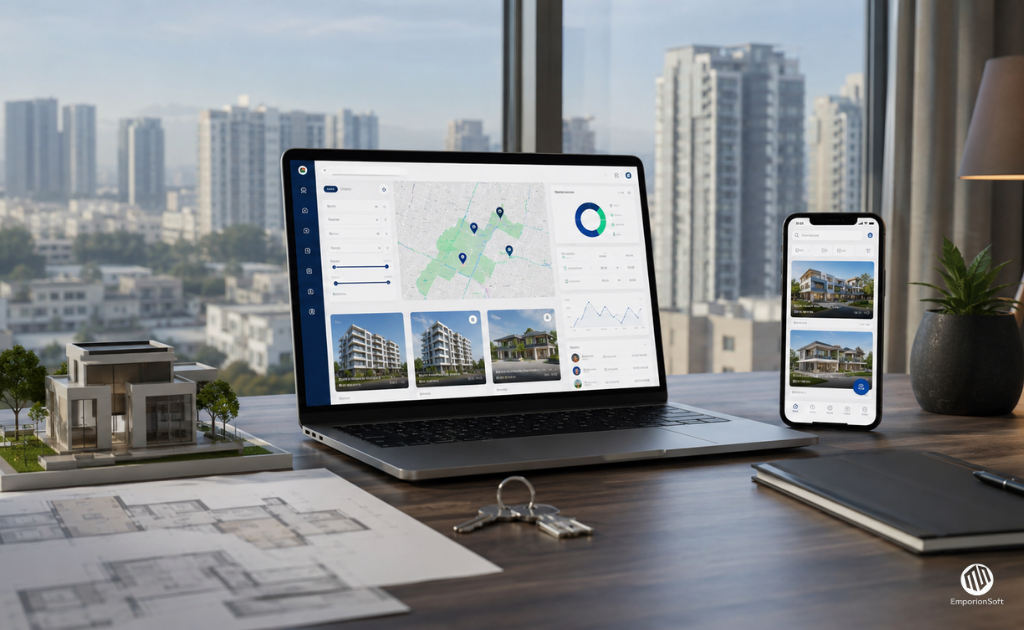
A property platform usually has more moving parts than it first appears to have. A buyer sees cards, images, filters, and maps. The business sees agents, approvals, duplicate listings, enquiries, price changes, featured placements, project inventory, rental terms, and follow up tasks.
That difference matters. A visual website can be launched quickly, but a property portal must be designed as a system.
For Pakistani real estate businesses, the commercial value usually sits in four areas:
- Better listing visibility across web and mobile
- Faster buyer and tenant enquiry handling
- Cleaner agent and developer coordination
- Stronger control over property data, approvals, and follow up
The broader technology market context covered in Pakistan IT Industry 2026 supports this direction, but the real opportunity is not “digital transformation” as a slogan. It is operational discipline.
A property portal succeeds when buyers find relevant properties faster, agents manage enquiries better, and owners can trust the data inside the platform. That is the foundation. Everything else, including mobile apps, CRM dashboards, map search, and multilingual content, depends on it.
What problem should a property portal solve before development starts?
A property portal should solve the problem of scattered property information, poor enquiry handling, weak listing quality, and manual agent coordination. Before development starts, the business must define whether it is building for buyers, agents, developers, landlords, tenants, investors, or all of them.
Many real estate projects fail at the planning stage because the owner starts with the phrase “we need a platform like Zameen.” That is understandable, but too broad. Zameen style search behaviour can inspire the product, but a niche platform needs its own operating model.
The first planning question should be simple: where is the current business losing control?
For some agencies, the problem is lead leakage. Enquiries arrive through calls, WhatsApp, Facebook, walk in visits, and property portals, but no one tracks which lead is serious, which agent followed up, or which listing generated interest.
For developers, the problem may be inventory visibility. Units, plots, villas, commercial shops, and payment plans are handled across spreadsheets and sales teams. When the information changes, buyers do not always see the latest availability.
For rental businesses, the issue may sit inside recurring management. Rent due dates, tenant communication, maintenance requests, lease renewals, and landlord reporting need more structure than a standard listing website can provide.
This is why property portal development Pakistan should begin with workflow mapping. The product must show which user does what, when they do it, what data they need, and what happens after each action.
A useful property platform usually has several journeys:
- Buyer journey
Search, filter, compare, save, enquire, schedule a visit, and follow up. - Seller or landlord journey
Submit property details, upload images, approve updates, and receive enquiries. - Agent journey
Add listings, manage leads, update status, schedule viewings, and track follow ups. - Developer journey
Manage project inventory, price plans, unit availability, payment schedules, and sales pipeline. - Admin journey
Moderate listings, approve users, control featured properties, manage cities and areas, and review platform performance.
EmporionSoft’s article on customer journey mapping for small business is useful here because property software touches multiple decision journeys at once. A buyer looking for a DHA plot behaves differently from a tenant searching for a furnished flat. A developer selling off plan apartments has different needs from a rental manager handling maintenance requests.
The second planning question is data quality. Property portals live or die on trust. Duplicate listings, outdated prices, missing images, vague locations, and unverified agents reduce buyer confidence quickly.
This is where custom software planning becomes important. A basic website cost estimate cannot capture the complexity of moderation workflows, approval states, CRM handover, listing expiry rules, and map based search. The cost logic explained in custom software development cost Pakistan applies directly because scope depends on workflow depth.
A strong planning phase should define:
- Listing types, such as houses, flats, plots, shops, offices, and projects
- User roles, such as admin, agent, buyer, developer, landlord, and tenant
- Approval rules for new and edited listings
- Search filters and location hierarchy
- Enquiry routing and CRM ownership
- Reporting needs for agents, branches, and developers
- Mobile requirements for buyers and field agents
The goal is not to over engineer the product before launch. The goal is to understand the business problem clearly enough that development decisions become grounded. When that happens, the feature set becomes much easier to shape.
What features does a property listing website need?
A property listing website needs structured listings, strong search filters, map integration, media galleries, enquiry forms, agent profiles, buyer accounts, saved searches, admin moderation, responsive design, and CRM support. Advanced portals may also need project inventory, rental management, plot management, multilingual content, and mobile apps.
The visible part of a property listing website is usually simple. A user searches, opens a listing, checks images, reviews price and location, then sends an enquiry. The hidden part is more complex. Someone has to add listings, approve them, update prices, remove expired properties, prevent duplicates, route enquiries, and track follow up.
That is why feature planning should be split into product areas.
Listing and search features
The listing system is the heart of the platform. It should support:
- Property type, purpose, price, area, and location
- Bedrooms, bathrooms, floor level, plot size, covered area, and furnishing status
- Images, videos, floor plans, and project documents
- Property status such as available, sold, rented, reserved, or under review
- Featured listings and promoted projects
- Related listings and recently viewed properties
Search filters need careful design because property buyers rarely search in one straight line. They compare location, budget, size, property type, and lifestyle context. In Pakistan, society and area based search can be especially important because buyers often search by DHA, Bahria Town, Gulberg, Johar Town, Scheme 33, or similar locality structures.
Map and location features
Map integration helps users understand where a property sits in relation to roads, areas, nearby facilities, and city boundaries. The Google Maps JavaScript API supports interactive website maps, markers, custom data, and map styling, which makes it relevant for property location browsing.
Location enrichment can go further. The Google Places API Nearby Search documentation explains how nearby places can be found by location and type, which can support neighbourhood context such as schools, hospitals, restaurants, or transport points when the use case justifies it.
Buyer and agent features
A buyer portal may include saved searches, favourite listings, enquiry history, alerts, and viewing requests. An agent portal may include listing submission, lead assignment, follow up status, availability updates, and profile management.
This is where a real estate CRM Pakistan workflow becomes valuable. The CRM does not need to be large in version one, but it should track who enquired, what they wanted, which agent owns the lead, what status the conversation reached, and when follow up is due.
Developer and project features
A developer focused platform may need:
- Project pages
- Unit and plot inventory
- Floor plans
- Payment plans
- Booking status
- Sales team access
- Document upload
- Buyer interest tracking
This is especially relevant for DHA property portal software, Bahria Town real estate software, and project specific platforms where inventory and payment structure matter more than public listing volume.
Admin and moderation features
Admin control separates a serious portal from a simple listing website. The admin system should handle:
- User roles and permissions
- Listing approval
- Agent verification
- Duplicate review
- Category and location management
- Featured property controls
- Enquiry visibility
- Reporting dashboards
A basic website may only need a contact form and listing pages. A real property portal needs role based management, data quality controls, and operational visibility. That distinction also explains why the cost discussion cannot be reduced to design alone.
How much does real estate app development Pakistan cost?
Real estate app development Pakistan cost depends on scope, user roles, platform type, design complexity, CRM depth, map features, admin controls, and post launch support. A basic listing website costs far less than a full property portal with mobile apps, agent workflows, rental management, and project inventory.
The most useful way to estimate cost is to separate property software into three levels.
| Build level | Typical scope | Suitable for | Cost driver |
|---|---|---|---|
| Listing website | Public listings, filters, enquiry forms, admin upload | Small agencies, niche property sites | Design, CMS, listing structure |
| Property portal | Buyer accounts, agent portal, CRM, map search, moderation | Agencies, developers, PropTech startups | User roles, search, workflows |
| Advanced PropTech platform | Mobile apps, rental management, plot inventory, analytics, integrations | Larger operators, developers, marketplaces | Architecture, scale, automation |
This structure is more useful than asking for one fixed number because the phrase “property portal” can mean very different things. A property listing website development Pakistan project may involve a responsive website with admin uploads. A property management software Pakistan project may involve tenants, landlords, rent records, maintenance, reminders, and reports. A PropTech platform may combine listings, CRM, mobile apps, payments, maps, and analytics.
The broader article on website development cost Pakistan 2026 helps explain website level pricing, but property portals move beyond standard web development once search logic, user roles, and operational workflows enter the picture.
Mobile apps change the budget again. If the business needs buyer and agent apps, push notifications, location based search, saved preferences, and profile management, then mobile app development cost Pakistan 2026 becomes the more relevant comparison point.
Several factors usually move the budget upward.
User roles
A portal with only public users and admins is simpler than one with buyers, agents, developers, landlords, tenants, branch managers, and super admins. Each role needs permissions, interfaces, and testing.
Listing complexity
A general property card is simple. A deep listing model that supports plots, flats, villas, commercial units, payment plans, rental contracts, and project inventory takes more planning.
Search and map depth
Basic filtering is cheaper than advanced location search, map markers, nearby places, saved searches, alerts, and custom ranking logic.
CRM and lead management
A basic enquiry form sends an email. A CRM workflow routes leads, tracks ownership, stores follow ups, and helps managers understand performance.
Admin moderation
Verification, approvals, duplicate checks, listing expiry, featured placements, and role based dashboards add operational strength but require more design and backend work.
Maintenance
Property portals need ongoing work after launch. Search filters evolve, listings grow, bugs appear, hosting needs change, and user behaviour reveals missing workflows. That is why app maintenance costs should be included in the commercial plan from the beginning.
For many founders, the best approach is not to build the largest version first. It is to build the smallest complete product that can run the target business model with confidence. That may be a niche property portal for one city, one society, one rental category, or one developer portfolio.
A cost effective first version should prove the workflow before expanding into advanced features such as mobile apps, AI search, automated valuation, payment integrations, or complex rental accounting.
Where property portals fail after launch and how to reduce the risk
Property portals usually fail after launch because listing quality, search experience, agent adoption, moderation, and lead handling are weak. The design may look professional, but the platform loses value when buyers find outdated listings, agents ignore enquiries, or admins cannot control data quality.
The first risk is duplicate and stale content. Real estate listings change quickly. Prices move. Properties get sold or rented. Agents repost the same unit. Photos become outdated. If the portal has no expiry rules, verification workflow, or update reminders, search quality drops.
The second risk is poor search relevance. A user who searches by location, budget, property type, and area expects accurate results. If filters are weak, location data is inconsistent, or listings are not structured properly, users leave. In property search, relevance is not a nice extra. It is the product.
The third risk is weak agent adoption. Agents will not consistently use a platform that slows them down. The agent portal must be fast, clear, and useful. If adding a property takes too long, or lead follow up is buried inside a confusing dashboard, the team will return to WhatsApp and spreadsheets.
The fourth risk is limited admin control. A serious portal needs moderation tools. Admins should be able to approve listings, manage locations, review agents, remove duplicates, feature properties, and monitor enquiry flow. Without this, the public product becomes messy over time.
The fifth risk is mobile experience. Many property searches start on mobile, even when the final decision happens through calls or visits. A portal that performs poorly on mobile devices creates friction for buyers and agents. Responsive design is not only a design standard. It affects enquiry volume and trust.
The W3C accessibility standards overview reinforces that web standards and accessibility matter for broad usability across users and devices. For property businesses, accessible design supports clearer navigation, readable content, better forms, and more inclusive access.
Testing helps reduce these risks before launch. A beta phase should include agents, admins, and real users, not only the internal project team. EmporionSoft’s beta testing guide is relevant because property portals contain many workflows that only show problems when real users try them.
A practical test plan should cover:
- Adding and editing listings across property types
- Searching by price, area, city, society, and property type
- Sending enquiries and assigning leads
- Managing listing approval and rejection
- Checking mobile responsiveness across common devices
- Testing map pins and location accuracy
- Reviewing duplicate and expired listing behaviour
- Measuring page speed on search and listing pages
Quality assurance should also test permissions. Agents should not see other agents’ private leads unless the business model allows it. Developers should only manage their own projects. Buyers should not access admin information. These role boundaries become more important as the platform grows.
That is why QA testing Pakistan fits naturally into a property portal project. Testing is not a final polish step. It protects trust, data quality, and the business model.
A property portal does not fail because it lacks every advanced feature. It fails when the essential workflows feel unreliable. Good launch planning reduces that risk by making quality part of the product, not a separate activity at the end.
Which technology architecture works best for real estate platforms?
The best architecture for a real estate platform usually combines a responsive frontend, structured backend APIs, a well designed database, search indexing, map services, admin tools, role based access, media storage, and optional mobile apps. The right stack depends on listing volume, user roles, search complexity, and CRM depth.
A simple agency website can often be built with a CMS. A serious portal needs a custom architecture because the data relationships are richer. Properties connect to agents, locations, projects, enquiries, media, users, saved searches, and status changes. If the foundation is weak, the platform becomes hard to scale and harder to maintain.
A typical architecture includes several layers.
Frontend layer
The frontend handles property search, listing pages, project pages, agent profiles, enquiry forms, dashboards, and public content. It must be fast, responsive, and easy to update. If the portal targets both desktop and mobile users, responsive design should be treated as a core requirement rather than a design option.
For complex portals, a modern frontend framework can help manage filters, interactive maps, saved searches, and user dashboards. The technology choice should support performance, SEO, and maintainability because property portals rely heavily on search visibility.
Backend and API layer
The backend manages users, listings, roles, enquiries, approvals, search logic, notifications, CRM events, and reporting. API design matters because web apps, mobile apps, and admin portals may all use the same backend.
The Node.js official about page describes Node.js as an asynchronous event driven JavaScript runtime designed for scalable network applications, which is why it often fits API driven platforms with frequent user actions, notifications, and admin events.
For architecture planning, scalable APIs for SaaS platforms is useful because property portals often behave like SaaS products internally. They support multiple roles, repeated workflows, stored data, permissions, and reporting.
Database and search layer
The database must support structured property data. That may include listings, users, roles, enquiries, cities, areas, societies, projects, agents, images, documents, and audit logs.
For many real estate platforms, a relational database works well because the data has clear relationships. Search may still need a separate indexing layer if filters, sorting, text search, and performance requirements become advanced. The tradeoffs covered in SQL vs NoSQL database are relevant here because property platforms need both structure and search flexibility.
Map and location services
Map integration usually includes pins, location search, coordinates, area boundaries, nearby places, and route context. Google’s Maps documentation supports interactive maps with markers and custom data, while Places APIs can support nearby location discovery where needed.
For Pakistan, location data needs extra care. Society names, phase numbers, blocks, sectors, and informal area naming can create inconsistencies. A good admin system should control city, area, society, phase, and block data instead of allowing uncontrolled text entry everywhere.
Mobile app layer
A mobile app is not always required for version one. It becomes useful when buyers need alerts, agents need field access, or developers want a dedicated experience for inventory and sales teams.
React Native supports building native apps for Android, iOS, and more using React, which makes it a practical option when a product needs cross platform mobile delivery.
The architecture should not chase complexity for its own sake. A good platform starts with the workflows that matter most, then leaves room for search scale, mobile apps, CRM integrations, analytics, and more advanced property management features later.
What a real international property portal case study teaches about execution
A real international property portal case study shows that execution matters more than a generic feature list. The value lies in how listings, roles, search, location data, admin control, and user journeys are connected into one stable property platform.
The Latvijas Objekti proof angle is important because it shifts the discussion from theory to delivery. A property portal is not only a collection of pages. It is a structured system where data quality, user permissions, search logic, and content management all affect commercial usefulness.
For Pakistani buyers, that matters because the local opportunity is not limited to broad portals. There is room for niche property platforms serving developers, rental operators, overseas investors, housing societies, agency groups, and city specific real estate businesses. International delivery experience can help because it shows that the team has worked with property data, listing structures, user expectations, and market specific workflows outside a narrow local pattern.
The first execution lesson is that listings need a disciplined data model. A property is not just a title, image, and price. It may include ownership status, purpose, location, area unit, amenities, nearby facilities, listing source, agent ownership, project association, media, documents, and availability status.
The second lesson is that roles must be clear. Admins, agents, developers, buyers, landlords, and tenants should not share one generic dashboard. Each role needs the right access and the right actions. Role based management protects data quality and makes the platform easier to operate.
The third lesson is that search must match real user behaviour. A buyer may search by city first, then society, then price, then plot size. A tenant may filter by bedrooms, furnishing, and monthly rent. A commercial buyer may care about road access, floor level, and area. Search should reflect those patterns.
The fourth lesson is that trust features should be designed early. Verification badges, agent profiles, moderation states, listing expiry, image quality rules, and enquiry logs all help reduce confusion. A portal without trust controls becomes a listing dump.
The fifth lesson is that admin tools need the same attention as public pages. Admins must review, approve, edit, feature, archive, and report on listings. If admin work is slow, the platform becomes operationally expensive.
This is where EmporionSoft’s case studies become relevant for a buyer evaluating delivery capability. A property founder should not only ask whether the team can design a modern interface. They should ask whether the team can connect the interface to a usable operating model.
The broader EmporionSoft services also matter because property portals usually need several capabilities together: UX design, frontend development, backend engineering, database planning, QA, deployment, and support.
A good property portal is rarely finished at launch. It improves as listings grow, agents use the system, buyers search more often, and operational patterns become visible. The first release should therefore be strong enough to operate, but flexible enough to evolve.
That is the execution mindset Pakistani real estate businesses should look for. Not a clone. Not a generic template. A focused platform that reflects the property workflow it is meant to serve.
How should Pakistani founders choose a real estate software development partner?
Pakistani founders should choose a real estate software development partner by testing workflow understanding, portal experience, technical depth, cost transparency, and post launch support. The right partner should explain how listings, search, maps, agents, leads, CRM, admin controls, and future scaling will work before writing code.
The first evaluation point is domain understanding. A team that treats a property portal as a normal website will likely miss important details. Real estate platforms need location hierarchy, duplicate prevention, listing moderation, agent ownership, enquiry routing, project inventory, and trust controls.
The second point is product discipline. A good partner should challenge a vague request for zameen.com clone development Pakistan and turn it into a sharper product plan. The better question is not how to copy a broad portal. The better question is which niche, workflow, and audience the platform should serve first.
That niche might be:
- DHA resale and rental listings
- Bahria Town project and plot management
- Developer inventory and sales portals
- Rental property management system Pakistan workflows
- Commercial property discovery
- Overseas Pakistani investment portals
- Agency network CRM and listing management
The third point is technical architecture. Ask how the team will model properties, users, roles, enquiries, locations, media, and projects. Ask how search will work. Ask how map pins will be managed. Ask whether the system will support future mobile apps without a major rebuild.
The fourth point is delivery process. A credible partner should be able to explain discovery, wireframes, database planning, UI design, backend development, admin build, QA, staging, launch, and maintenance. If the process is vague, the result often becomes vague too.
The fifth point is cost clarity. Real estate app development Pakistan cost should be explained by scope, not guessed from a few screenshots. A serious proposal should define what is included, what is excluded, what assumptions were made, and what may change the budget.
EmporionSoft’s guide on questions to ask a software house Pakistan fits this decision stage because vendor selection is not only about price. It is about judgment, reliability, communication, and long term fit.
A practical evaluation checklist looks like this:
- Can the team explain your property workflow clearly?
- Can they separate must have features from later phase features?
- Can they design admin tools, not only public pages?
- Can they support map based search and structured location data?
- Can they build CRM or lead handling logic?
- Can they test across user roles and devices?
- Can they support the platform after launch?
For many property businesses, the right first release is not the largest product. It is the smallest complete system that can run the target workflow properly. That might be a developer portal with unit inventory, a rental platform with tenant management, or an agency listing system with CRM.
A soft planning conversation can prevent expensive mistakes. If you are shaping a property platform and want to validate scope before requesting a full build, an EmporionSoft consultation can help turn the idea into a practical roadmap.
The strongest property portals are built from business clarity, not feature volume. Once the audience, workflow, data model, and operating rules are clear, the software becomes much easier to design, build, test, and grow.
How much does a property portal cost in Pakistan?
A property portal in Pakistan can range from a basic listing website to a full PropTech platform with mobile apps, CRM, maps, admin controls, and rental or plot management. Cost depends on scope, user roles, search depth, design quality, integrations, and post launch support.
How is real estate software built?
Real estate software is usually built by mapping user roles, defining listing data, designing search and enquiry workflows, building frontend and admin interfaces, developing backend APIs, testing across devices, and launching in controlled phases. Strong projects start with workflow clarity before interface design.
What features does a property listing website need?
A property listing website needs structured listings, filters, images, location details, map support, enquiry forms, agent profiles, admin moderation, responsive design, and lead tracking. More advanced platforms may include saved searches, CRM workflows, project inventory, rental management, and mobile apps.
Should a founder build a Zameen style clone?
Usually not as a first step. A better approach is to build a focused portal for a defined audience, such as one city, society, agency network, developer portfolio, or rental category. A niche platform is easier to launch, manage, test, and improve.
Can real estate software support DHA, Bahria Town, rentals, and plots?
Yes, but the data model must be planned properly. DHA and Bahria Town workflows may need phases, blocks, sectors, plot files, project inventory, and location controls. Rental systems may need leases, tenants, rent tracking, maintenance requests, and landlord reporting.